
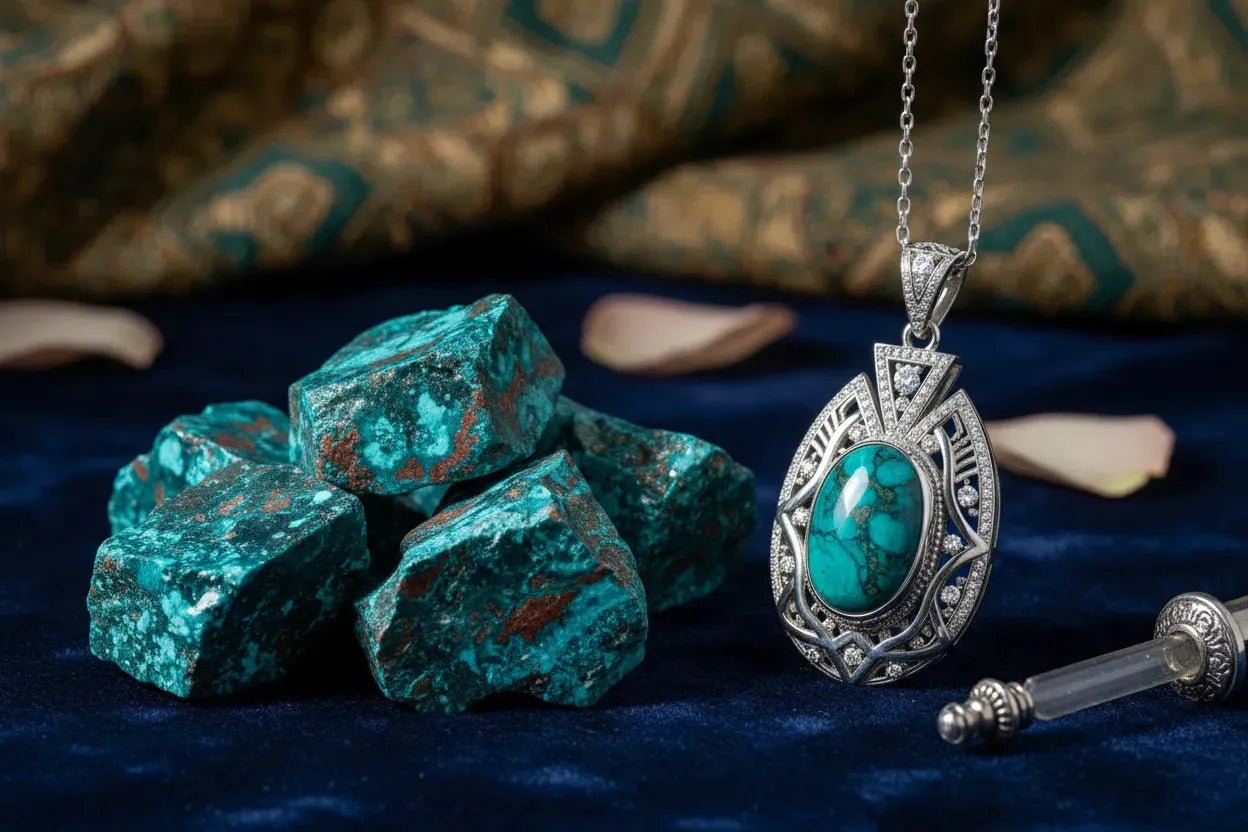
Chrysocolla: Deep Blue and Feminine Power in Sterling Silver
Chrysocolla Spotlight
Table of Contents
- Introduction
- Characteristics of Chrysocolla
- History and Symbolism
- Varieties and Natural Associations
- Meaning and Virtues
- Deposits Around the World
- Chrysocolla Jewelry at Vindicta
- The Vindicta Perspective
- Care and Advice
- Stones to Discover
- Frequently Asked Questions
- Conclusion
Introduction
Chrysocolla is one of the most visually striking stones in jewelry. Its intense blue-green hue — ranging from electric turquoise blue to deep emerald green, sometimes with shades of sky blue or forest green — possesses a chromatic intensity that few other stones can match. It's a stone that immediately captures the eye and doesn't let go.
A hydrated copper silicate (Cu₂H₂Si₂O₅(OH)₄), chrysocolla belongs to the large family of copper stones — alongside malachite and turquoise. It is copper (Cu²⁺) that gives it this intense blue-green color, the same element that turns copper roofs verdigris and gives the sky in certain volcanic regions an ethereal hue. Paired with solid 925 silver, it creates jewelry of absolutely unique chromatic intensity and marine elegance.
Characteristics of Chrysocolla
Composition and Structure
- Mineral: hydrated copper silicate (Cu₂H₂Si₂O₅(OH)₄)
- Color: electric turquoise blue to deep emerald green, due to copper (Cu²⁺)
- Appearance: opaque, waxy to vitreous luster, soft and homogeneous texture
- Crystal system: amorphous to microcrystalline (no visible crystals)
Hardness and Resistance
- 2.5 to 3.5 on the Mohs scale — a soft stone, to be handled with care
- Very porous — easily absorbs liquids, oils, and dyes
- Sensitive to acids (even weak ones) and chemicals
- Exception: gem silica (silicified chrysocolla) reaches 6-7/10 — much more suitable for jewelry
Physical Properties
- Density: 1.9 to 2.4 (light for a stone)
- Transparency: opaque (translucent for gem silica)
- Cleavage: absent (irregular fracture)
History and Symbolism of Chrysocolla
Chrysocolla has been known and used since ancient times. Its name comes from the Greek chrysos ("gold") and kolla ("glue") — Greek and Roman goldsmiths used it as a flux for soldering gold, taking advantage of its copper content which lowers the melting point. Pliny the Elder mentioned it in his natural encyclopedia as an essential material in ancient goldwork.
In ancient Egypt, chrysocolla was used in jewelry and decoration from at least 3,000 BC. Its blue-green color was associated with fertility, rebirth, and divine protection. The goddess Hathor, patroness of beauty and love, was sometimes depicted with chrysocolla ornaments. Hathor's priestesses wore chrysocolla necklaces during ritual ceremonies.
Chrysocolla is often associated with Queen Cleopatra VII, who allegedly wore chrysocolla jewelry and used crushed stone as eyeshadow. According to some ancient sources, she also offered chrysocolla to her guests as a diplomatic gift — a stone of seduction and power. This association — real or legendary — gives it an aura of royal femininity and seduction that transcends centuries.
In ancient copper mines — Cyprus, Sinai, Timna — chrysocolla was extracted alongside metallic copper. Miners considered it a sign of copper's presence in the ground — a guide stone that indicated rich veins. This function as an "indicator stone" gave it practical as well as aesthetic value.
In Islamic and Ottoman tradition, blue-green stones were associated with Paradise and divine blessing. Chrysocolla, with its intense blue-green and soft texture, was worn as a talisman of peace, communication, and protection. Ottoman jewelers used it in prestigious women's jewelry, often associated with turquoise and malachite.
Varieties and Natural Associations of Chrysocolla
Chrysocolla is rarely found pure — it is often associated with other copper minerals in spectacular natural combinations:
- Pure Chrysocolla: intense turquoise blue, soft and porous (2.5-3.5/10), most common
- Gem Silica (silicified chrysocolla): chrysocolla impregnated with silica, much harder (6-7/10), translucent, turquoise blue of exceptional depth and beauty — the most valuable variety, mainly found in Arizona
- Chrysocolla-Malachite: natural association of blue chrysocolla and green malachite in the same stone — spectacular concentric patterns, striking blue and green contrast
- Chrysocolla-Azurite: association of turquoise chrysocolla and deep blue azurite — one of the most spectacular combinations in mineralogy
- Chrysocolla-Turquoise: often found together in the same deposits, sometimes indistinguishable to the naked eye
- Chrysocolla-Quartz: chrysocolla in a white quartz matrix, striking chromatic contrast
Meaning and Virtues of Chrysocolla
Emotional & Spiritual Level
- Communication & Expression 💙: stone of authentic speech, creative expression, and benevolent communication
- Feminine Wisdom: associated with feminine energy, gentleness, intuitive wisdom, and quiet strength
- Calm & Soothing: calms intense emotions, reduces stress, and promotes serenity
- Throat Chakra: promotes the expression of truth with gentleness and clarity, without aggression
- Transformation: stone of change and adaptation — like copper transforming into chrysocolla on contact with water, it symbolizes the ability to evolve
- Empathy: promotes understanding of others and the ability to listen benevolently
Physical Level (lithotherapy beliefs)
- Associated with the relief of chronic tension and nervous stress
- Used to improve sleep quality and promote recovery
- Considered a healing stone for throat and thyroid problems
- Associated with hormonal balance and the nervous system in lithotherapeutic tradition
Note: The virtues of lithotherapy are not scientifically proven and do not replace medical advice.
Chrysocolla Deposits Around the World
- Peru (Atacama, Cerro Verde): high-quality chrysocolla, intense colors, often associated with malachite and azurite — some of the most beautiful specimens in the world
- Chile (Chuquicamata): significant production, variable quality, one of the largest copper mines in the world
- Arizona (USA, Morenci, Globe): gem silica (silicified chrysocolla) of the highest global quality, exceptional translucent blue
- Democratic Republic of Congo (Katanga): abundant chrysocolla, often associated with malachite, variable quality
- Israel (Timna, "King Solomon's Mines"): historical deposit exploited since antiquity, gem-quality chrysocolla
- Australia (Queensland): variable quality chrysocolla, often associated with other copper minerals
Chrysocolla Jewelry at Vindicta
Chrysocolla is one of the most demanding stones we work with. Its softness (2.5-3.5/10) imposes specific setting constraints — the stone must be protected by a suitable mounting, and we prefer gem silica (silicified chrysocolla) for its superior hardness. But when the combination works, the result is immediately striking: this intense blue-green against the luster of solid 925 silver creates a contrast of rare visual strength.
Discover our natural stone 925 silver jewelry collection to explore our creations in chrysocolla and other fine stones.
The Vindicta Perspective
Chrysocolla is the stone that raises the most questions for us about the boundary between stones. It is often confused with turquoise, amazonite, or malachite — and it is often found associated with these stones in nature, in combinations that defy classification. It is a stone of blurred boundaries, which makes it particularly interesting for a jeweler seeking originality.
What fascinates us most of all is gem silica — silicified chrysocolla from Arizona. It is one of the rarest and most beautiful stones in the world — a translucent turquoise blue of absolutely unique intensity and depth. It rivals the most beautiful Persian turquoises in beauty and often surpasses them in transparency and luster. When one sees a quality gem silica for the first time, one immediately understands why some gemologists consider it one of the most beautiful stones in the world.
Chrysocolla is also the stone that most reminds us of the importance of copper origin in our selection. With malachite and turquoise, it forms a trilogy of copper stones — three different expressions of the same element, three complementary beauties that together tell the story of copper in human jewelry. Copper is one of the first metals worked by humans — and its stones are among the oldest in jewelry.
Finally, chrysocolla is the stone that poses the most ethical challenges for us. Its softness and porosity make it vulnerable to undeclared treatments — impregnated with resin or wax to harden and stabilize it. At Vindicta, we only work with natural chrysocolla or certified gem silica, and we always specify this. Transparency regarding treatments is non-negotiable.
Care and Advice for your Chrysocolla Jewelry
- Water: absolutely avoid immersion — chrysocolla is very porous and absorbs liquids, which can alter its color and structure
- Acids: avoid all contact with acidic substances, even weak ones (vinegar, lemon juice, acidic perspiration)
- Chemicals: absolutely avoid perfumes, creams, detergents, and oils — chrysocolla absorbs them and can discolor or degrade
- Cleaning: soft dry cloth only. If necessary, a very slightly damp cloth and immediate drying. Never use an ultrasonic cleaner or steam
- Storage: soft fabric pouch, separately from all other stones and jewelry
- Impacts: avoid impacts — chrysocolla is soft and can scratch or crack easily
- Wearing: remove your jewelry before showering, swimming, sports, and any physical activity
To go further: Complete care guide for your 925 silver jewelry.
Stones to Discover
If chrysocolla fascinates you, these stones will share your appreciation for intense blue-green materials steeped in history:
- 🔵 Turquoise — historic blue-green, chrysocolla's older sister, harder and richer in symbolism
- 💚 Malachite — intense green and concentric bands, same copper origin, often associated with chrysocolla in nature
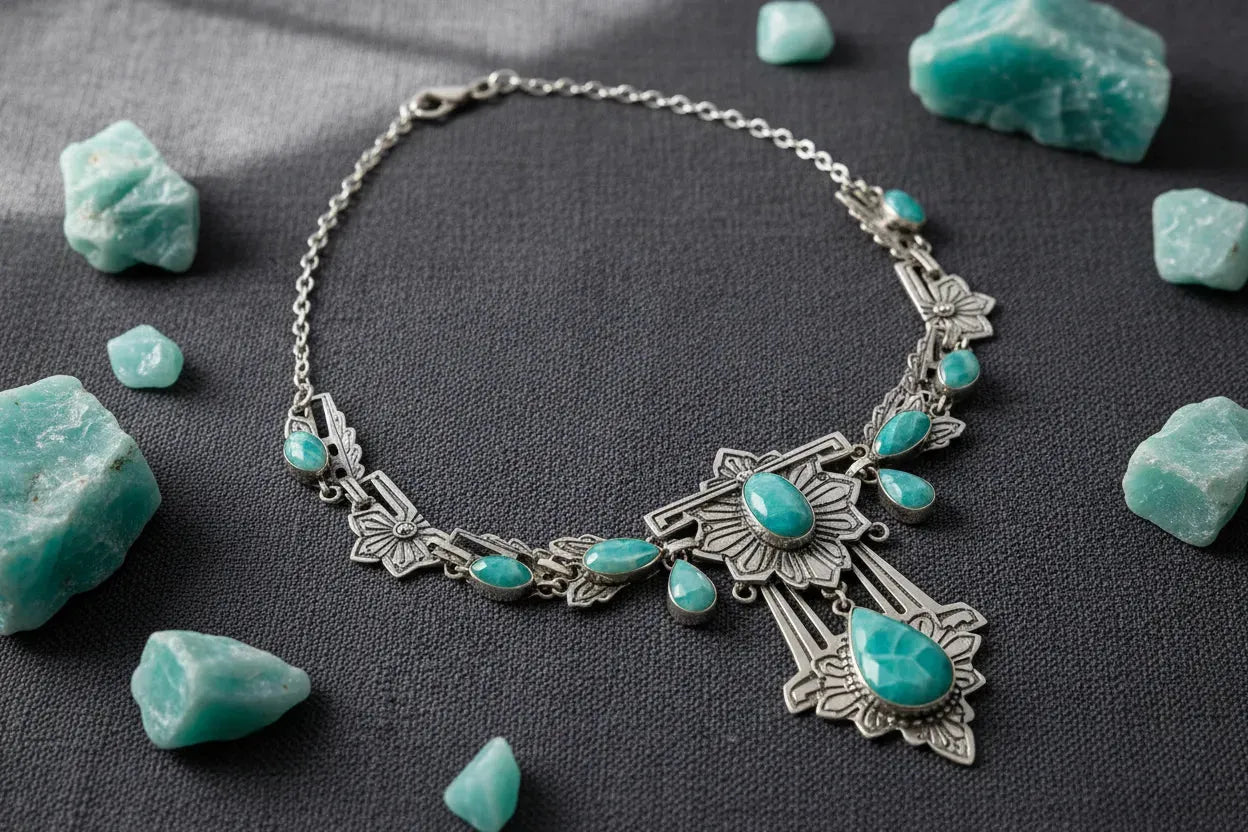
- 💚 Amazonite — soft, milky blue-green, often confused with chrysocolla but with a calmer character
- 🔵 Lapis Lazuli — royal blue and gold, same chromatic intensity and ancient history
- 💙 Aquamarine — crystalline blue-green, same marine evocation but transparent
- 📖 Complete Guide to Natural Stones 2026 — everything you need to know about stones in jewelry
Frequently Asked Questions About Chrysocolla
What is the difference between chrysocolla and turquoise?
Both are blue-green copper stones, but they are different minerals. Turquoise is a copper and aluminum phosphate, harder (5-6/10) and with an older and richer jewelry history. Chrysocolla is a copper silicate, softer (2.5-3.5/10) and more porous. Turquoise is generally more valuable, but gem silica (silicified chrysocolla) can surpass it in beauty and transparency.
What is gem silica and why is it so rare?
Gem silica is chrysocolla naturally impregnated with silica (SiO₂) which makes it much harder (6-7/10) and translucent. This process occurs when siliceous solutions penetrate chrysocolla and fill its pores — a rare geological phenomenon that only occurs under specific conditions. It is mainly found in Arizona (USA) and is considered by many gemologists to be one of the most beautiful stones in the world.
Is chrysocolla often treated?
Yes — this is one of the major problems in the chrysocolla market. Its exceptional porosity makes it vulnerable to undeclared treatments: impregnated with resin or wax to harden and stabilize it, dyed to intensify its color. These treatments are often undeclared. At Vindicta, we only work with natural chrysocolla or certified gem silica.
Is chrysocolla suitable for daily wear?
Standard chrysocolla (2.5-3.5/10) is not suitable for daily wear — it is too soft and too porous. For regular wear, we recommend gem silica (silicified chrysocolla, 6-7/10) which offers much greater resistance. In any case, prefer a pendant or earrings over a ring to minimize the risk of scratches and impacts.
How to distinguish chrysocolla from turquoise with the naked eye?
This is often difficult, even for experts. Some clues: chrysocolla generally has a more intense and electric color than turquoise. It is lighter (density 1.9-2.4 vs 2.6-2.9 for turquoise). Turquoise often has brown or black limonite veins, absent in pure chrysocolla. Certain distinction requires gemological analysis.
Conclusion
Chrysocolla is an exceptional stone — visually striking, steeped in 5,000 years of human history, from Cleopatra to contemporary copper mines. Its intense blue-green color, its natural association with malachite and turquoise, and the exceptional rarity of gem silica make it one of the most fascinating stones in jewelry.
Paired with solid 925 silver, chrysocolla creates jewelry of absolutely unique chromatic intensity and marine elegance — pieces that carry within them the color of the sea, the symbolism of authentic communication, and the millennia-old history of copper in human jewelry.
✦ Vindicta — Solid 925 silver
The piece that makes the difference
Certified 925 silver · Free shipping from €69 · 10 years of excellence
Natural Stone Jewellery →



Leave a comment
This site is protected by hCaptcha and the hCaptcha Privacy Policy and Terms of Service apply.