
Cossack Jewelry: Massive Signet Rings and Warrior Symbols in 925 Silver
In the history of Eastern Europe, there is a figure who embodies virility, freedom, and raw power better than any other: the Cossack. Elite horsemen, fearsome warriors, guardians of the steppes of Ukraine and Russia, the Cossacks developed a unique material culture—including solid 925 sterling silver jewelry of incomparable strength and singularity. From massive signet rings to battle amulets, their silver jewelry served as objects of power, protection, and identity.
At Vindicta, a solid 925 sterling silver jewelry house with over 10 years of excellence, we select pieces that embody this spirit: massive, engraved, imbued with an undeniable presence.
The Cossacks: Free Warriors of the Steppes
The Cossacks emerged as a distinct military and cultural force from the 15th century onwards, in the steppes between Russia, Ukraine, and Poland. Neither serfs nor nobles, they formed a separate society—free men, organized into sotnia (centuries) and kosh (armies), governed by their own laws and their own leaders, the hetmans.
This fundamental freedom is reflected in their material culture: Cossacks did not wear the codified jewelry of the nobility. They wore warrior jewelry—functional, symbolic, massive. Solid silver was their metal of choice: hard enough to withstand the rigors of military life, noble enough to assert their status.
The Cossack Signet Ring: A Piece of Combat and Identity
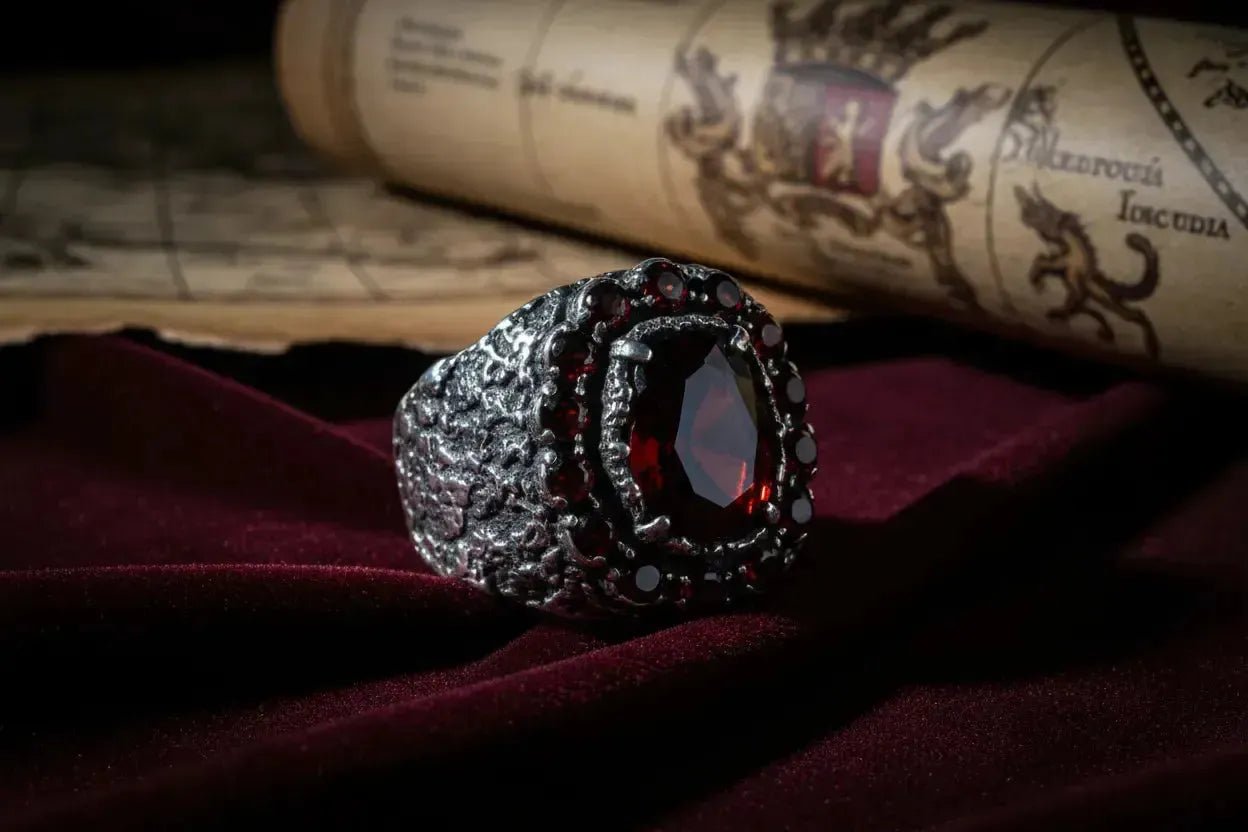
The signet ring is the quintessential Cossack piece of jewelry. Massive, made of solid 925 sterling silver, it served several functions simultaneously:
- Personal seal — Cossack officers engraved their initials or coats of arms to authenticate their orders
- Auxiliary weapon — a massive silver signet ring strengthens the fist in close combat
- Protective amulet — engraved with protective symbols, Orthodox crosses, Slavic runes
- Identity marker — each Cossack regiment had its own symbols, worn with pride
- Currency of exchange — if necessary, the solid silver could be melted down or exchanged
Cossack signet rings are distinguished by their imposing size, deep engravings, and rejection of any superfluous ornamentation. No delicate filigree, no colorful enamel—just solid silver, bare metal, worked with force.
Warrior Symbols in Cossack Jewelry
Cossack symbolism is rich and codified. On their solid silver jewelry, we find:
- The saber (chachka) — the emblematic weapon of the Cossacks, engraved on signet rings as a symbol of bravery
- The eight-pointed star — an ancestral Slavic symbol of divine protection
- The Orthodox cross — indestructible faith, asserted Christian identity against Ottoman invaders
- The horse — the Cossack's lifelong companion, a symbol of freedom and power
- The eagle — vision, height, mastery of territory
- Geometric interlaces — continuity, strength, belonging to the community
Cossack Silver: Between Orthodoxy and Pagan Tradition
Cossack jewelry is fascinating in its duality: deeply Orthodox Christian on one hand, heir to ancient Slavic pagan traditions on the other. Thus, on a single 925 sterling silver signet ring, one might find an engraved Orthodox cross next to a pre-Christian solar symbol, or a Slavonic inscription encircling an ancestral geometric motif.
This unique synthesis—Christian faith and pagan memory—gives Cossack solid silver jewelry a symbolic depth unmatched elsewhere in European jewelry.
The Stones of the Cossack Warriors
When Cossacks set stones in their solid silver, they choose with intention:
- Black onyx — absolute protection, inner strength, intimidation
- Red carnelian — courage, vital energy, blood shed for freedom
- Tiger's eye — vigilance, determination, strategic vision
- Dark garnet — passion, loyalty, sacrifice
No delicate stones, no pastel colors—only stones that speak of strength, determination, and character.
The Cossack Heritage in Contemporary Men's Jewelry
The Cossack aesthetic—massive, engraved, symbolic, uncompromising—is one of the most powerful influences in high-end contemporary men's jewelry. Men who reject generic jewelry and seek pieces with a story, an identity, and a presence naturally turn to these ancestral visual codes.
Our men's 925 sterling silver signet rings and our men's 925 sterling silver rings are part of this tradition of powerful and meaningful men's jewelry. The warrior stones of the Cossacks are found in our collections black onyx jewelry, carnelian jewelry, and tiger's eye jewelry—all set in certified solid 925 sterling silver.
To delve deeper into the history of Eastern European warrior jewelry, read our articles on Eastern European signet rings and on Orthodox 925 sterling silver jewelry. And to guarantee the authenticity of your purchase, discover our quality commitment.
✦ Vindicta — Argent 925 Massif
La pièce qui fait la différence
Certifié argent 925 · Livraison offerte dès 69€ · 10 ans d'excellence
Chevalières Homme Argent 925 →