The Byzantine legacy in Greek silverwork
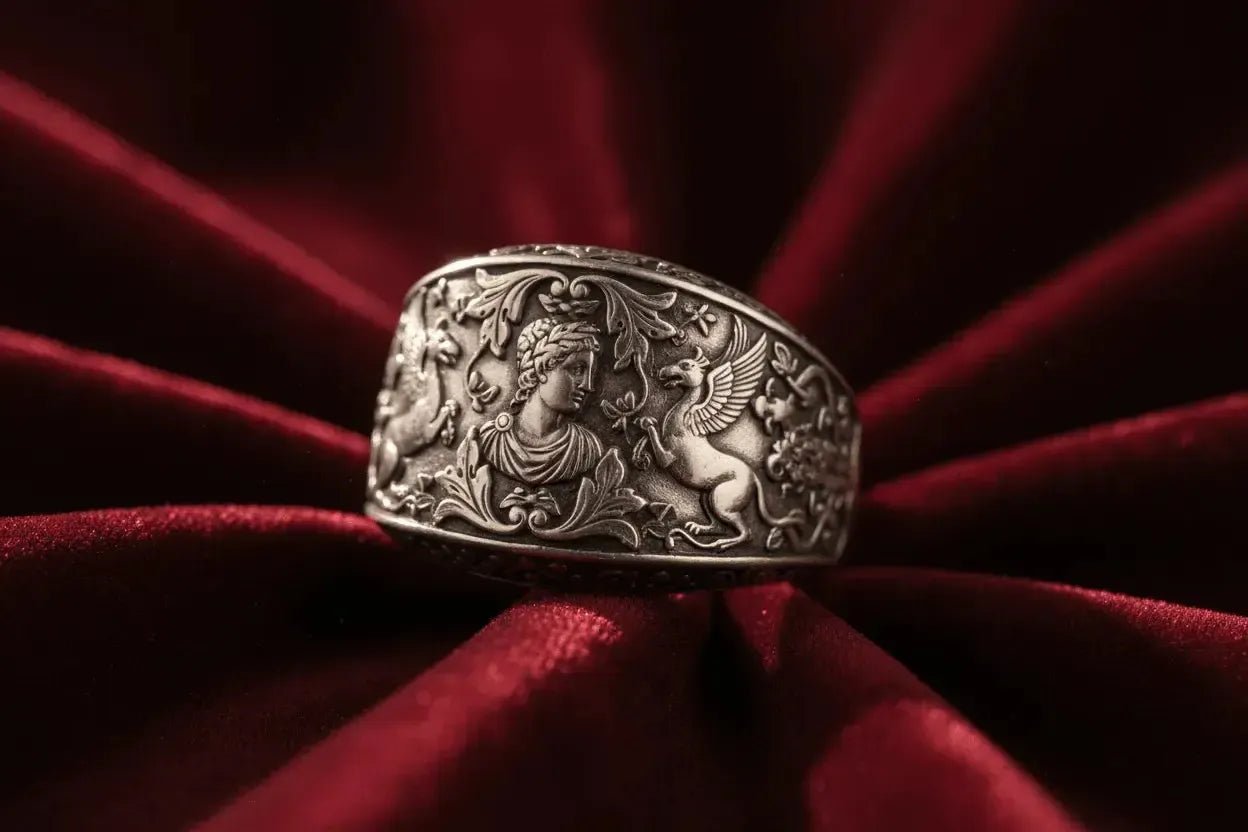
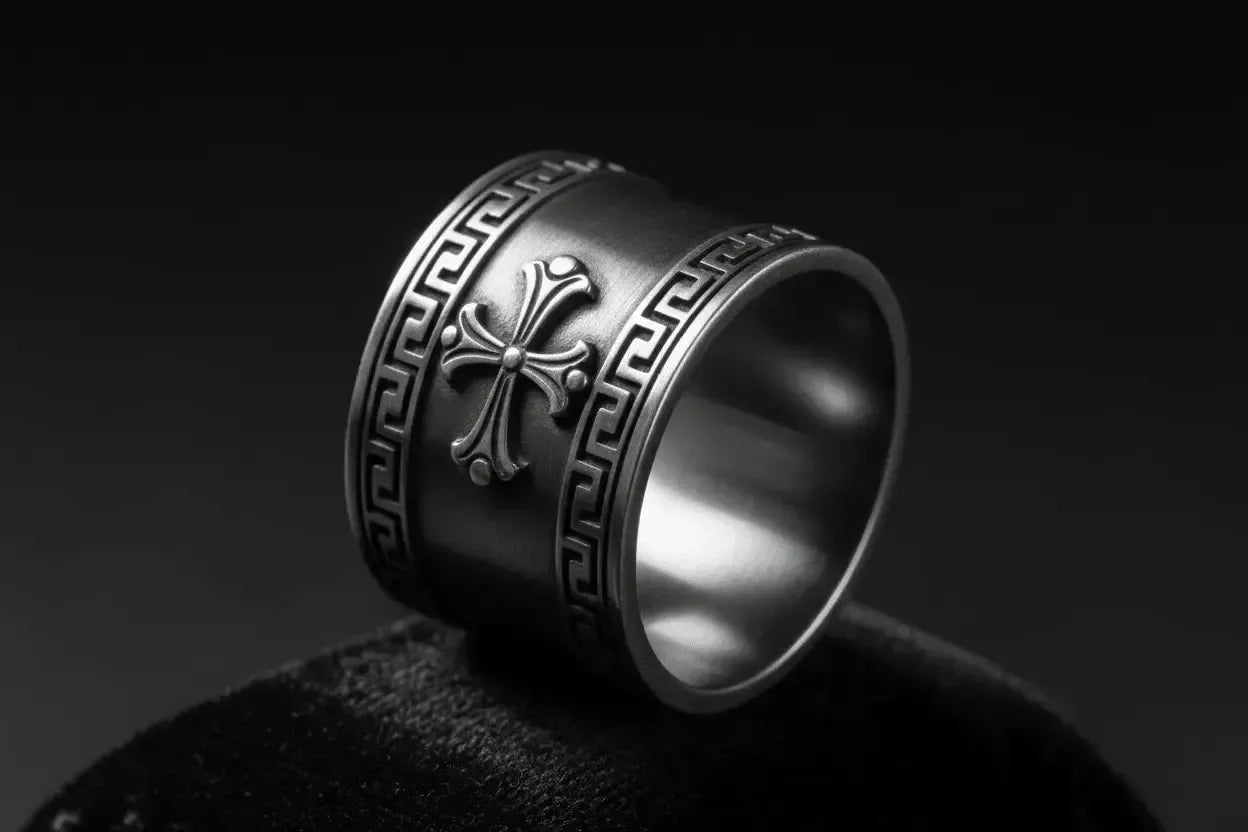
There exists an empire whose borders disappeared six centuries ago, but whose artistic imprint remains visible today in every Greek jewel that bears a meander, a double-barred cross, or an acanthus leaf motif. The Byzantine Empire — Eastern Christian Rome, heir to ancient Greece and Eastern tradition — developed silver jewelry of unparalleled sophistication in medieval Europe for eleven centuries.
Understanding this heritage means understanding why certain motifs found on contemporary 925 silver rings have traversed fifteen centuries without losing their power — because they are not mere decorations, but visual languages full of meaning.
Constantinople: The Capital of Gold and Silver
Constantinople, founded in 330 AD by Emperor Constantine on the site of ancient Byzantium, was for over a millennium the richest city in the Western world. Its position at the crossroads between Europe and Asia made it a hub for all trade — especially the trade of precious metals.
Imperial workshops in Constantinople produced silverware for the court, for the church, and for export to the kingdoms of Western Europe, which considered Byzantine objects the epitome of luxury and refinement. The techniques mastered by Byzantine silversmiths — cloisonné enamel, niello, repoussé, granulation — were the most advanced of their time and would be copied throughout Europe for centuries.
Silver held a special place in this production. If gold was the metal of the emperor and God, silver was the metal of the church and the people — used for reliquaries, ornate icons, processional crosses, but also for jewelry worn by the middle classes of the empire, who could not afford gold but refused bronze.
The Greek Meander: A Motif Traversing Millennia
Among all the motifs inherited from Greek antiquity and transmitted by Byzantium, the meander is the most universal. This broken line that folds back on itself at right angles — inspired, according to legend, by the meanders of the Maeandros River in Asia Minor — already appears on Greek pottery from the 9th century BC.
Byzantine silversmiths adopted and transformed it: the meander became a border, a frame, a filling motif that structured the surface of the jewel without ever overwhelming it. Its perfect geometry — repetitive but never monotonous — created a visual rhythm that attracted the eye and guided it along the jewel.
This motif is not just a decoration. In Greek tradition, the meander symbolizes eternity — endless movement, the renewing cycle. Worn on a jewel, it is a silent affirmation of continuity, permanence, and connection to something beyond the individual.
Cloisonné Enamel: The Technique That Defined Byzantine Goldsmithing
If the meander is the most recognizable motif in Byzantine silverware, cloisonné enamel is its signature technique. The principle is deceptively simple: thin metal partitions are soldered onto a gold or silver plate to delimit cells, and then these cells are filled with colored glass powder that is melted in a kiln. The result is an enameled surface with intense, unalterable colors that seem to emit their own light.
Byzantine silversmiths brought this technique to a level of perfection unmatched until the 19th century. Enamelled icons, reliquaries, and imperial crowns preserved in the treasures of European cathedrals bear witness to a technical mastery and chromatic sensitivity that remain dazzling.
This technique was transmitted to Western Europe by Byzantine silversmiths who fled Constantinople after the sack of 1204 by the Crusaders, and then after the fall of the city in 1453. They brought with them their tools, their enamel formulas, and their motif notebooks — and spread to workshops in Venice, Rome, Paris, and Cologne.
Contemporary Greece: A Living Heritage
Today, contemporary Greek goldsmithing maintains a constant dialogue with this Byzantine heritage. Workshops in Athens, Thessaloniki, and the islands produce 925 silver jewelry that reinterprets Byzantine motifs — meanders, crosses, acanthus leaves, interlaces — in a contemporary language without betraying them.
This continuity is not nostalgic. It is functional: these motifs still work because they were designed with a geometric rigor that transcends trends. A meander on a 925 silver ring worn today in Paris or Amsterdam is as legible and beautiful as it was on a 10th-century Byzantine jewel.
At Vindicta, several of our solid 925 silver jewels are directly inspired by this tradition: the precision of the geometric motif, the rigor of repetition, the conviction that the beauty of a jewel does not age when it is anchored in a solid formal logic. This is the Byzantine heritage — not as a citation, but as a method.
✦ Vindicta — Solid 925 silver
The piece that makes the difference
Certified 925 silver · Free shipping from €69 · 10 years of excellence
Discover our jewellery →