Gdańsk and the Amber Road: Poland's Treasure
There exists a material that is neither stone nor metal, that burns like wood and floats on water, that can trap an insect forty million years old and deliver it intact to the light. This material is amber. And for two millennia, the city of Gdańsk has been its world capital.
To understand Gdańsk is to understand why amber is not a seaside curiosity. It is a fossilized resin that structured the trade exchanges of all of Northern Europe during Antiquity and the Middle Ages — and which continues today to be worked in the workshops of the old town with a precision inherited from centuries of know-how.
The Amber Road: 4,000 years of trade
Before the Silk Roads, before the Spice Roads, there was the Amber Road. It connected the shores of the Baltic Sea — where autumn storms washed blocks of fossil resin onto the beaches — to the great Mediterranean civilizations that craved it: Greece, Rome, Egypt.
The Romans called amber electrum or succinum. Pliny the Elder, in the 1st century AD, precisely described the trade routes that brought Baltic amber to Rome, where it was worth more than gold at certain times. Emperor Nero reportedly sent a Roman knight specifically to the Baltic to bring back enough to decorate the arena during a gladiatorial show.
The main route started from the coasts of present-day Poland and Lithuania, crossed the Vistula southwards, passed over the Carpathians, followed the Danube, and ended in Aquileia, a large Roman port on the Adriatic. Gdańsk — then known as Gyddanyzc in medieval chronicles — was at the heart of this network, at the mouth of the Vistula, where the sea delivered its treasures and where merchants came to buy them.
Gdańsk: the city that made amber an art
In the Middle Ages, the guild of amber craftsmen in Gdańsk was one of the most powerful and secretive in Europe. Officially founded in 1477, it controlled not only the trade of raw material but also its transformation into works of art: rosaries, jewelry boxes, chess pieces, frames, and of course, jewelry.
Gdańsk's master amber craftsmen had developed cutting and polishing techniques that revealed the transparency and depth of the resin without making it fragile. They knew how to heat amber to clarify it, dye it, and melt it into larger blocks. They knew the difference between cognac amber — the most common — and the extremely rare milky white amber, called royal or osseous, which was worth ten times more.
The most famous piece from this tradition is the Amber Room, commissioned by King Frederick I of Prussia at the beginning of the 18th century and presented to Peter the Great of Russia. Completely lined with carved amber panels, gilded and inlaid with mirrors, it was considered the eighth wonder of the world — before being dismantled and stolen by the Nazis in 1941. Its location remains one of the great mysteries of art history.
Baltic amber: a living material
What distinguishes Baltic amber — called succinite by geologists — from all other fossil resins in the world is its succinic acid content. This molecule, present at 3 to 8% in authentic Baltic amber, gives it special properties: a warmth to the touch that no stone has, a surprising lightness, and this ability to charge with static electricity when rubbed — a phenomenon that gave its name to electricity itself, from the Greek elektron, amber.
Baltic amber has been forming for about 44 million years, from the resin of a now-extinct coniferous forest that covered northern Europe. The inclusions — insects, plants, air bubbles — sometimes found in raw pieces are windows into a prehistoric world. A mosquito trapped in amber 40 million years ago is more intact than a fossil in rock.
Gdańsk today: amber as identity
Walking through the old town of Gdańsk today means passing dozens of amber shops and workshops. Mariacka Street, paved and lined with houses with carved stoops, is entirely dedicated to jewelers and artisans who work the resin. Some workshops have been in the same family for four or five generations.
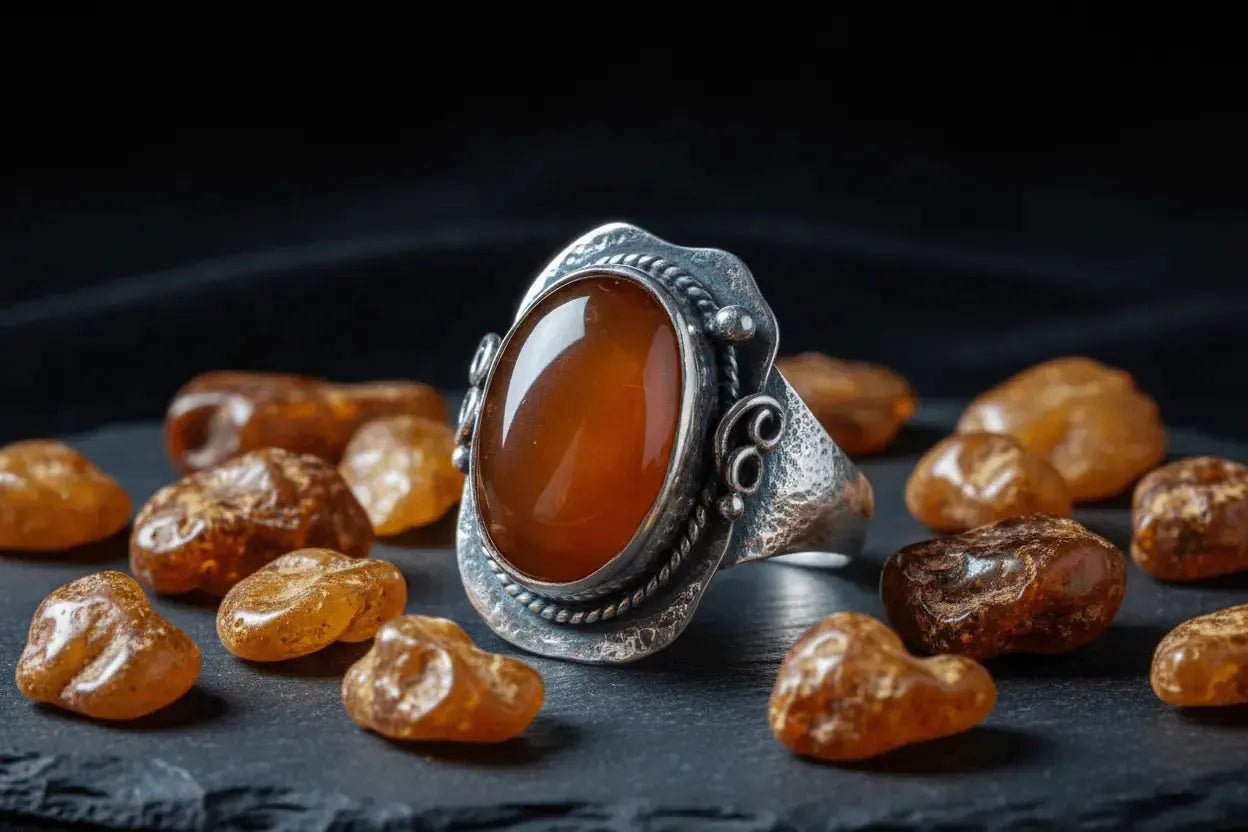
Amber is worked here in two ways: raw, to reveal its inclusions and natural transparency, or set in silver — and this is where the two traditions meet. The metal that best accompanies Baltic amber, one that does not steal its thunder and matches its warm tones, is silver. Not gold, which is too dominant. Solid 925 silver, whose cool hue creates a perfect contrast with the cognac, honey, or cherry tones of the resin.
This alliance between Baltic amber and solid 925 silver is one of the oldest in European silversmithing. It spans centuries without aging, because it rests on a simple logic: two natural materials, each irreplaceable, mutually enhancing each other.
✦ Vindicta — Solid 925 silver
The piece that makes the difference
Certified 925 silver · Free shipping from €69 · 10 years of excellence
Discover our jewellery →