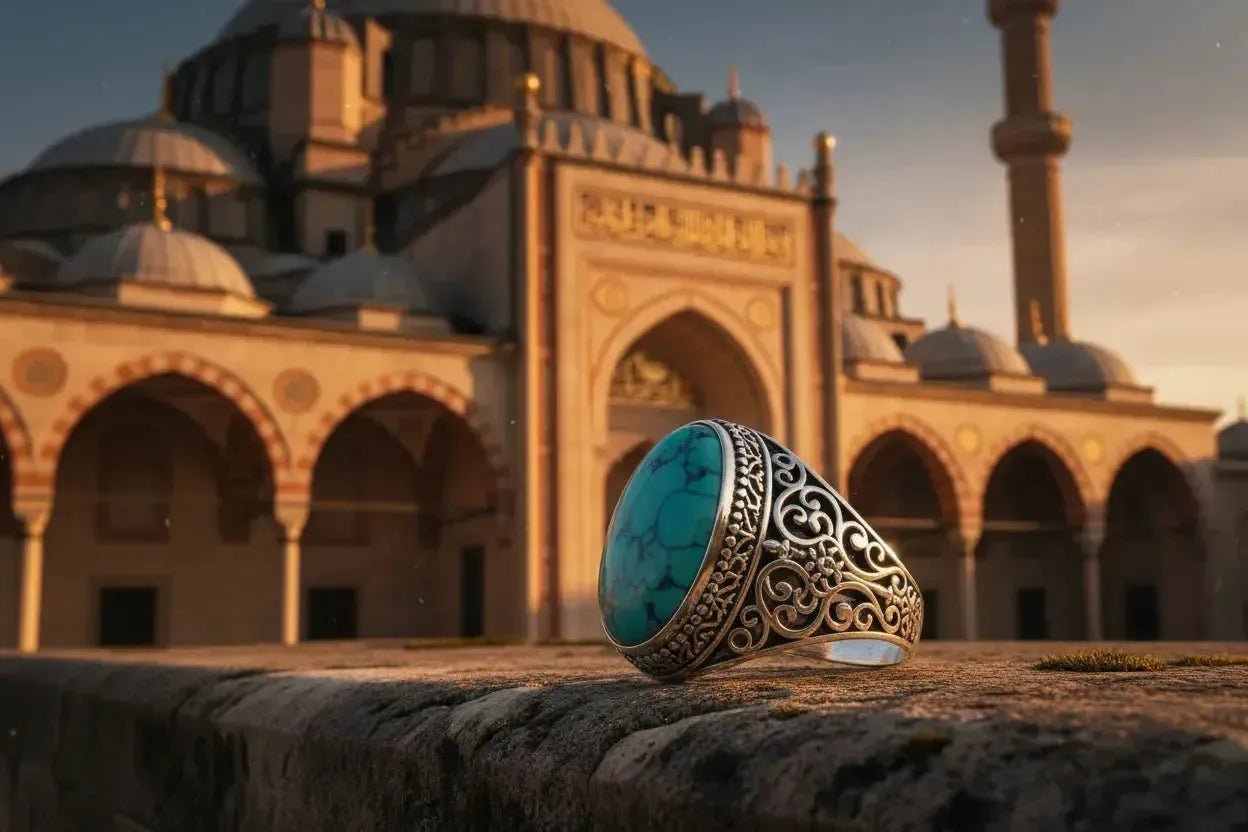
The Topkapi Palace Treasury: Imperial Jewels and Silver Heritage
In the heart of Istanbul, overlooking the Bosphorus for over five centuries, the Topkapi Palace is much more than a historical monument. It is the guardian of an unparalleled jewelry treasure — thousands of gold and silver pieces, set with rubies, emeralds, turquoise, and diamonds, silent witnesses to the splendor of the Ottoman Empire. At Vindicta, with over 10 years of excellence in selecting 925 sterling silver jewelry, we draw our inspiration from this imperial heritage to offer you pieces that perpetuate its spirit.
Topkapi: The Beating Heart of the Ottoman Empire
Built starting in 1459 by order of Sultan Mehmed II — the conqueror of Constantinople — Topkapi Palace was the primary residence of the Ottoman sultans for nearly four centuries. Over 25 sultans reigned there, from Mehmed II to Abdülmecid I, making this palace the nerve center of an empire that stretched from Algeria to Iraq, from the Balkans to Arabia.
But Topkapi was not just a government palace. It was also a center of artistic and artisanal creation of unprecedented intensity. The imperial workshops — the Ehl-i Hiref — employed hundreds of elite artisans: goldsmiths, jewelers, embroiderers, calligraphers, miniaturists. The best artisans of the empire, and often beyond, converged on Topkapi to serve the court.
The Imperial Treasure: What the Halls of Topkapi Hold
The Topkapi Treasury is today one of the most visited rooms in the world. It houses pieces of invaluable historical and artistic worth.
The Topkapi Dagger
Perhaps the most famous piece of the treasure — made world-renowned by the film Topkapi (1964). This gold dagger set with three enormous emeralds and a hidden watch under the largest stone is the perfect example of Ottoman jewelry genius: beauty serving function, wealth serving power.
The Spoonmaker's Diamond
The Kaşıkçı Elması — the 86-carat diamond surrounded by 49 smaller diamonds — is one of the largest diamonds on display in the world. Its story, mixing legend and reality, perfectly illustrates the Ottoman fascination with exceptional stones.
Stone-Inlaid Thrones
The Ottoman thrones displayed at Topkapi are entirely covered with precious stones — turquoise, rubies, emeralds, pearls — set in gold and silver with precision that defies imagination. Each stone was chosen not only for its beauty but for its symbolic meaning.
The Sultan's Jewelry
The Topkapi Harem housed the jewelry of the sultanas — pieces of extraordinary delicacy. Rings, bracelets, necklaces, earrings in silver and gold, adorned with turquoise, carnelian, mother-of-pearl, and rare precious stones. These pieces were not mere ornaments — they were instruments of power, markers of status, diplomatic gifts.
The Imperial Stones of Topkapi
Turquoise: Stone of the Empire
Turquoise is omnipresent in the Topkapi treasure. The sultans wore it as a protective talisman — convinced that this blue stone protected them from combat wounds and the evil eye. The turquoise domes of Ottoman mosques are no coincidence: it is the color of divine protection.
Carnelian: Stone of Warriors
The orange-red carnelian adorned the rings of warrior sultans. Mehmed II, Selim I, Suleiman the Magnificent — all wore carnelian rings. This stone symbolized courage, vitality, and victory in battle. The Prophet himself, according to Islamic tradition, wore a carnelian ring — making it the most sacred stone in Ottoman jewelry.
Onyx: Stone of Majesty
Black onyx was the stone of silent majesty. Its absolute black contrasting with the brilliance of silver or gold created a visual effect of immediate authority. The Grand Viziers and high dignitaries of the Ottoman court were particularly fond of it.
Sultanite: Born on Ottoman Soil
Sultanite — this chameleon stone that changes color depending on the light — is mined only in Turkey, in the Milas region. Its very name pays homage to the Ottoman sultans. It is the stone most intimately linked to the Ottoman heritage — a gem that exists nowhere else in the world.
The Imperial Workshops: When Art Becomes Heritage
What distinguishes Topkapi jewelry from other royal treasures is the technical mastery of the artisans who created them. The Ehl-i Hiref — the "people of the craft" — were organized into specialized guilds:
- The zergerân: goldsmiths, masters of working with gold and silver
- The kuyumcular: jewelers, specialists in setting precious stones
- The mücevherciler: gemologists, responsible for evaluating and selecting stones
- The telkâri ustaşı: masters of filigree, creators of metal lace
These techniques — filigree, chasing, repoussé, setting — are the same ones we mention in our article on the secrets of Ottoman artisans. A direct link between Topkapi and the pieces we select today.
From Topkapi to Vindicta: The Continuity of a Heritage
Obviously, the jewelry we select at Vindicta are not the imperial jewels of Topkapi. But they are their spiritual heirs — pieces that perpetuate the same aesthetic codes, the same stones, the same techniques, the same philosophy of jewelry as an object of meaning and durability.
When you wear a men's 925 silver ring adorned with turquoise, you are wearing the same stone that adorned the rings of the sultans of Topkapi. When you choose a 925 silver signet ring with carnelian, you are perpetuating a tradition that dates back to Suleiman the Magnificent.
This is not marketing. This is history.
Visiting Topkapi: What to See
- The Treasury (4th courtyard) — the Topkapi dagger, the Spoonmaker's Diamond, the inlaid thrones
- The Sacred Relics Chamber — the Prophet's personal belongings, including his carnelian ring
- The Harem apartments — to understand the role of jewelry in the lives of the sultanas
- The Miniatures Room — to see how jewelry was represented in Ottoman art
The Living Heritage
The Topkapi treasure is not a static museum. It is a living source of inspiration for all who believe that beauty has a story, that objects have a soul, and that some things are worth passing on rather than discarding.
At Vindicta, we select each piece of solid 925 sterling silver with this conviction: that behind every piece of jewelry, there is a story worth wearing. Not a seasonal accessory — a heritage.
Explore our natural stone 925 silver jewelry, our women's 925 silver rings, our men's 925 silver rings, and our Art Deco 925 silver jewelry — pieces that carry the soul of Topkapi.
All our jewelry is certified solid 925 sterling silver. Consult our authenticity page.
✦ Vindicta — Solid 925 silver
The piece that makes the difference
Certified 925 silver · Free shipping from €69 · 10 years of excellence
Oriental 925 Silver Jewellery →