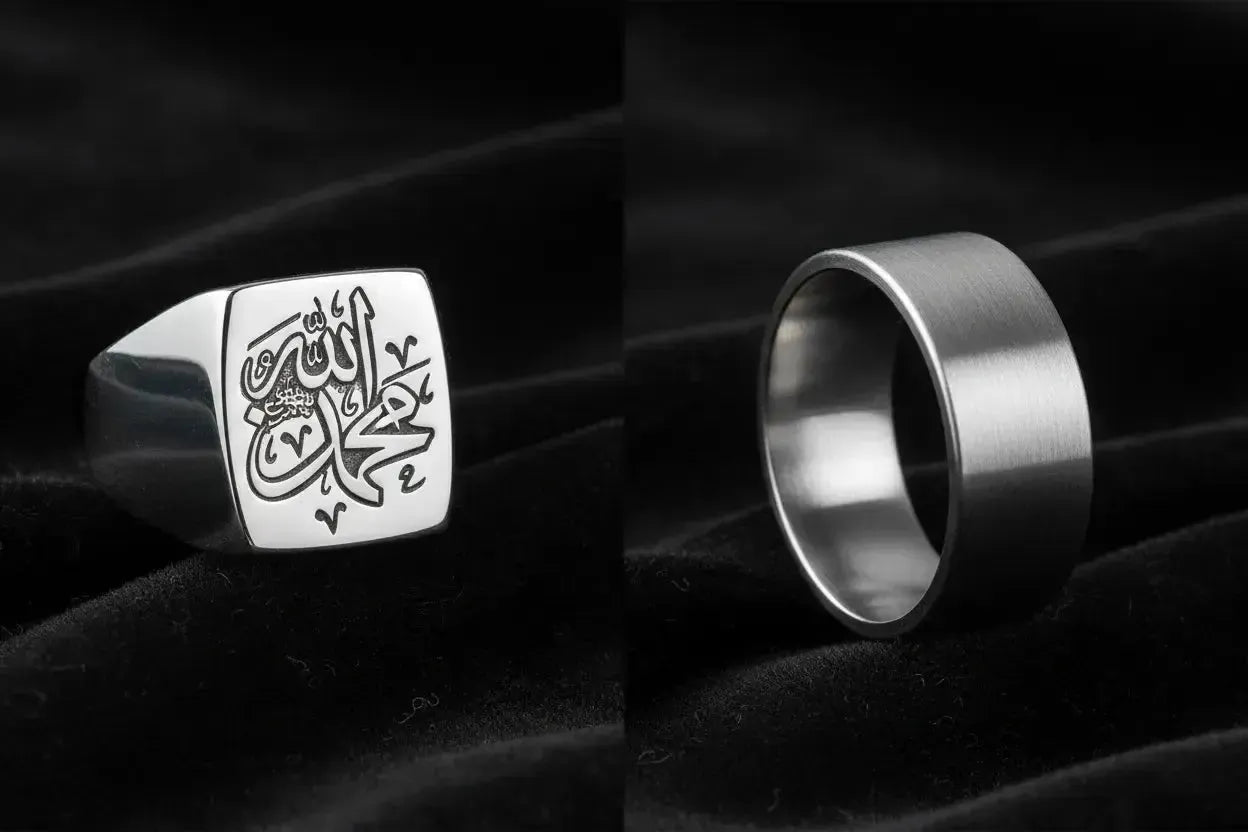
The art of Ottoman chasing: why Turkish rings are unique in the world
There are jewels you buy, and jewels you receive. Rings rooted in Ottoman tradition fall into the latter category. Not because they are necessarily more expensive, but because they carry something that the eye perceives without always being able to name it: the trace of a hand, a tool, a gesture repeated thousands of times until perfection. This something is chasing.
For those who wish to wear this heritage daily, our collection of men's 925 silver rings gathers pieces selected for their artisanal authenticity and quality craftsmanship.
What is Chasing?
Chasing is a silversmithing technique that involves working the surface of a metal using small tools called chasing tools — steel rods with finely sculpted tips. The artisan strikes these tools with a hammer, creating reliefs, hollows, and three-dimensional patterns directly in the material.
Unlike engraving, which removes material, chasing displaces it. The metal is pushed, molded, sculpted without loss. It's a technique that requires an intimate knowledge of the metal — knowing exactly how much pressure to apply, what angle to adopt, and how the metal will react under the tool.
925 silver is the metal of choice for this technique. Its malleability allows it to accept the finest details without cracking, while retaining the necessary rigidity to hold its shape once the work is complete. Discover why this metal is so special in our article Why Choose 925 Silver Jewelry.
The Ottoman Empire and the Obsession with Detail
The Ottoman Empire, at its zenith in the 16th and 17th centuries, developed a jewelry culture unparalleled in history. The workshops of the Topkapi Palace in Istanbul employed hundreds of specialized artisans — each a master of a precise technique, passed down from master to apprentice over decades.
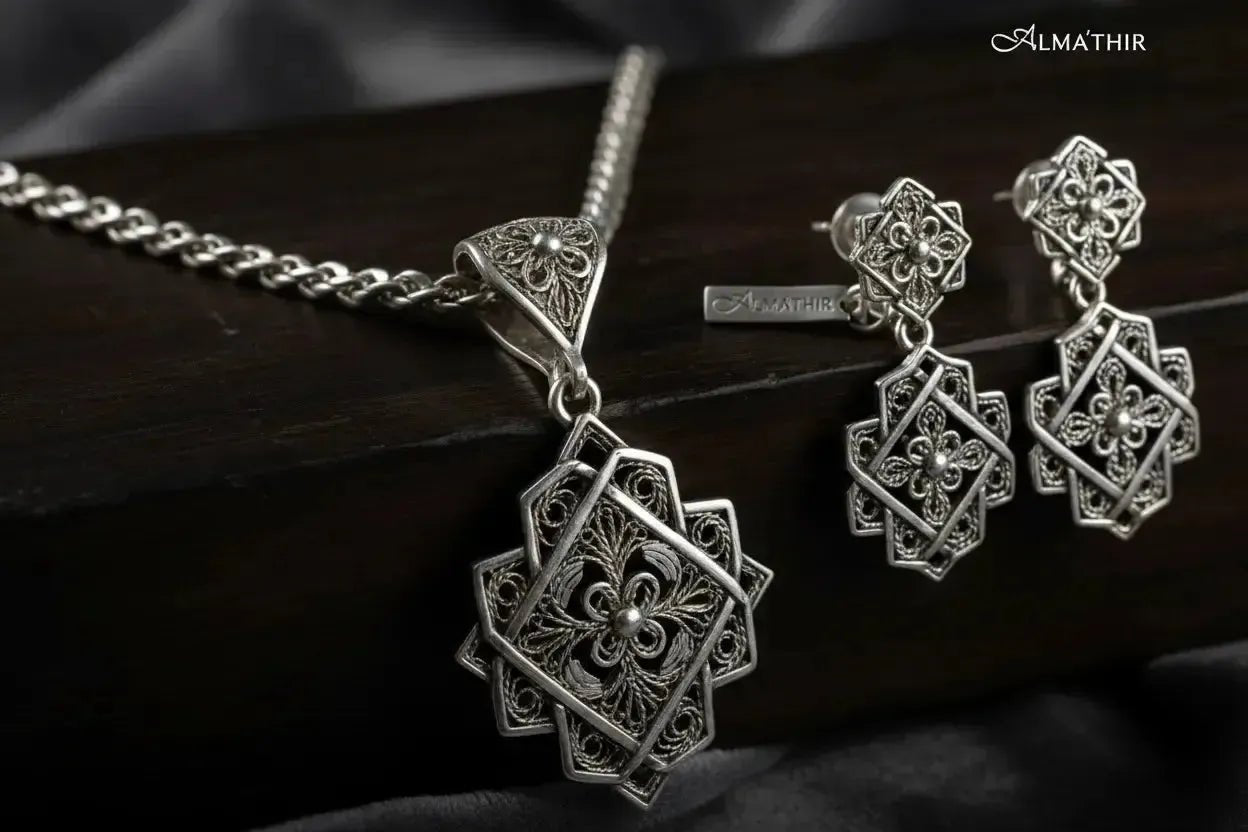
What distinguishes Ottoman chasing from other jewelry traditions is its particular relationship to motifs. Where other cultures prioritize strict symmetry or figurative representation, Ottoman art developed arabesques — intertwining plant and geometric forms that unfold infinitely, without apparent beginning or end.
These motifs are not decorative in the superficial sense of the term. They reflect a cosmology: the idea that beauty is an attribute of the divine, and that the artisan who creates beauty participates in something beyond them. Each arabesque chased in silver is as much a meditation as an adornment. To delve deeper into this world, consult our article on arabesque motifs in 925 silver jewelry.
Why Turkish Rings are Unique
The Density of the Motif
A chased ring in the Ottoman tradition leaves no empty surface. Every square millimeter is worked, every area is filled with a motif. This density is not excess — it's a philosophy. Emptiness does not exist in Ottoman art: it is always filled with something significant.
The Stone-Metal Alliance
Ottoman chasing doesn't stop at the metal. It creates a setting for natural stones — turquoise, carnelian, onyx, zultanite — which integrate into the motif as if they had always been part of it. The setting is not an addition: it is a continuation of the design.
Black onyx in a chased setting creates a striking contrast between the deep black of the stone and the brilliance of the worked silver. The orange carnelian brings a warmth that softens the coldness of the metal. Turquoise evokes the domes of Ottoman mosques — that celestial blue that spans centuries without aging.
The Transmission of the Gesture
What makes a Turkish ring truly unique is that the gesture that created it has not changed for centuries. The chasing tools used today in workshops in Istanbul or Ankara are direct descendants of those from the 16th century. The hand that strikes the hammer reproduces a movement learned from a master, who in turn learned it from another.
It is this continuity of gesture that gives the pieces their irreplaceable character. A hand-chased ring cannot be perfectly reproduced — each piece is unique, bearing the imperceptible micro-variations of the hand that created it.
How to Recognize True Artisan Chasing
- Slight irregularities: hand-chasing exhibits tiny variations in the depth and spacing of motifs. Absolute perfection is a sign of mechanical production.
- Depth of relief: artisan work creates more pronounced reliefs, with smoother transitions between high and low areas.
- The 925 hallmark: every authentic sterling silver piece bears this engraved hallmark. Consult our guide to recognizing true 925 silver quality.
- Weight: solid 925 silver is noticeably heavier than plated metal imitations.
Wearing a Chased Ring Today
The Ottoman chased ring is not a museum piece. It is meant to be worn, lived with, and embraced. In a world where everything looks the same, it asserts individuality — the choice of something with a history, an origin, a reason for being.
It can be worn alone, as a central piece of a minimalist look. Or layered, mixed with simpler bands that give full prominence to the chased motif. Consult our guide on finger symbolism to choose the placement that matches your intention.
At Vindicta — 10 years of excellence in selecting 925 silver jewelry — we choose each piece for the quality of its artisanal work and its faithfulness to this Ottoman heritage. Not reproductions. Pieces that continue a tradition. Find our commitments on our authenticity page.
Additional Articles
✦ Vindicta — Solid 925 silver
The piece that makes the difference
Certified 925 silver · Free shipping from €69 · 10 years of excellence
Oriental 925 Silver Jewellery →