
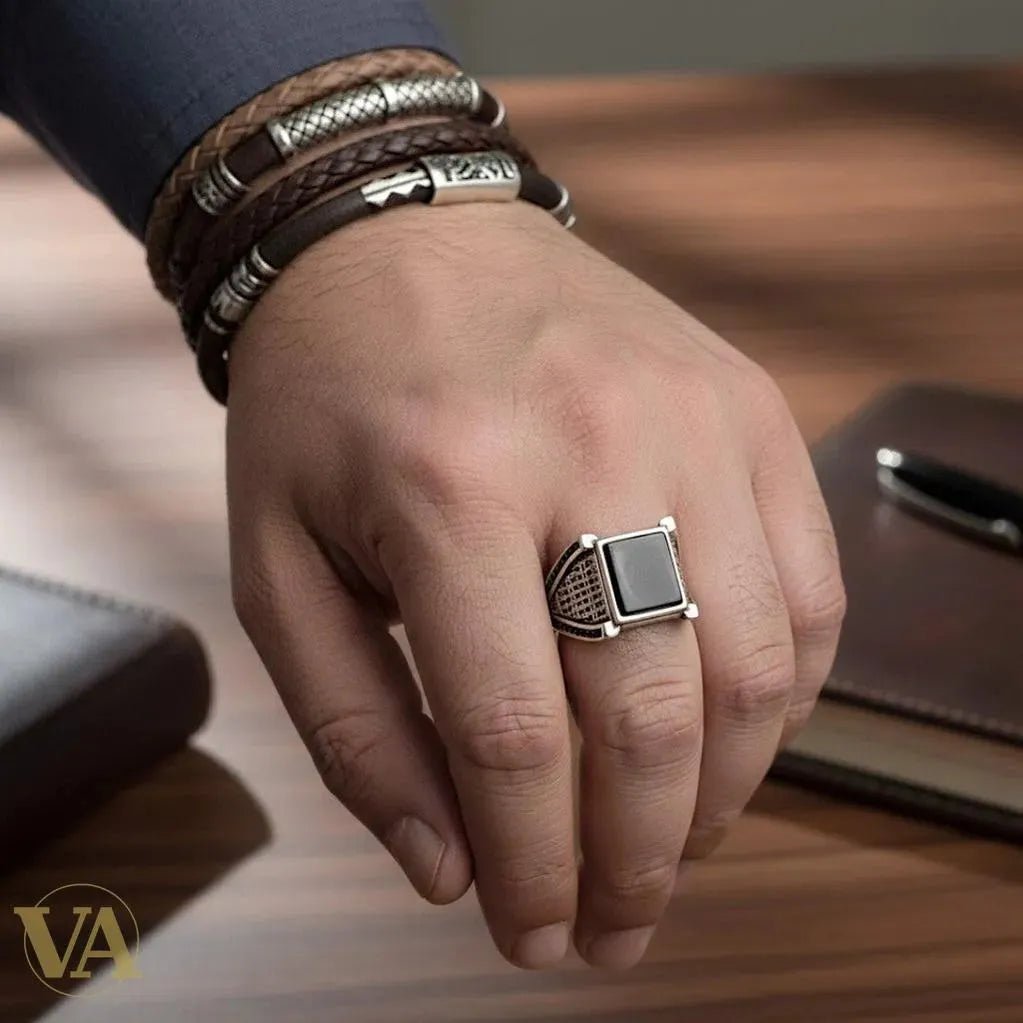
Ottoman Men's Style: Imperial Heritage 925 Silver Jewelry
Some styles are not invented—they are passed down. Ottoman men's style is one of them: born in the courts of Constantinople, worn by sultans, viziers, and elite warriors, it now embodies a rare, sovereign masculinity deeply rooted in six centuries of imperial history.
To wear an Ottoman jewel is to choose a language. The language of a man who knows his history—and refuses to betray it for fleeting fashion.
The Ottoman Empire and the Culture of Men's Jewelry
Between the 14th and 20th centuries, the Ottoman Empire dominated three continents. At its peak under Suleiman the Magnificent (1520–1566), Constantinople was the world capital of goldsmithing. The workshops of the Grand Bazaar produced pieces of unparalleled sophistication: signet rings with engraved bezels, solid silver seal rings, intricately carved bracelets adorned with turquoise and carnelian.
Jewelry was not merely an accessory—it was a sign of rank, belonging, and power. Each motif had a meaning: the crescent for faith, the interlacing for eternity, the stone for protection.
This culture of men's jewelry, passed down from generation to generation, is now accessible through solid 925 silver pieces that perpetuate these ancestral codes.
Visual Codes of Ottoman Men's Style
Ottoman style is immediately recognizable by its formal characteristics, inherited directly from imperial jewelry:
Architectural Forms
Ottoman jewelry is inspired by mosque and palace architecture: strict geometric forms, perfect symmetry, imposing volumes. The Ottoman signet ring is square, oval, or hexagonal—never round and commonplace. It occupies space with authority.
Engraved Motifs
The Greek meander, floral arabesques, geometric interlacings, stylized calligraphy—these motifs transform each ring into a miniature work of art. Such engravings require hours of artisanal work and cannot be reproduced by industrial processes without losing their soul.
Natural Stones
In Ottoman tradition, each stone possesses a virtue and a meaning:
- Black Onyx — a stone of protection and authority, worn by warriors and judges → Black Onyx Jewelry
- Turquoise — a stone of travel and luck, a talisman for Ottoman horsemen → Turquoise Jewelry
- Carnelian — a stone of courage and vitality, mentioned in classical Islamic texts → Carnelian Jewelry
- Agate — a stone of grounding and inner strength, used in official seals → Agate Jewelry
Solid 925 Silver: The Imperial Metal
Gold was reserved for sultans. Solid silver was the metal of powerful men—viziers, janissaries, prosperous merchants. Its cool, lunar color, its capacity to be intricately carved with extreme precision, and its durability over generations made it the natural choice for master goldsmiths in Istanbul, Aleppo, and Damascus.
Today, solid 925 silver remains the only metal worthy of perpetuating this heritage. Silver plating, which oxidizes and tarnishes in a few months, betrays the Ottoman spirit—that of durability and transmission.
How to Build an Ottoman Men's Style in 2026?
The Signet Ring: Foundational Piece
Every Ottoman wardrobe begins with a signet ring. It is the most symbolically charged piece—a direct heir to the seal rings that authenticated imperial decrees. It is worn on the index or ring finger of the right hand, with an assertive presence.
Criteria for a true Ottoman signet ring: large bezel, engraved motif or set natural stone, hallmarked solid 925 silver.
👉 Discover our Men's 925 Silver Signet Ring collection
Mastered Layering
Men of the Ottoman court wore several rings simultaneously—never at random. The golden rule: one imposing piece + one or two delicate pieces, same metal, complementary or identical stones. Ottoman layering is not superposition—it is a composition.
Example: black onyx signet ring on the index finger + minimalist grooved band on the ring finger + delicate turquoise ring on the middle finger. Three pieces, one coherence.
Pairing with Outfits
Ottoman men's style transcends modern dress codes. It pairs equally well with:
- A dark suit (wool or linen) — the signet ring replaces the watch as a status marker
- A premium casual look (white shirt, tailored trousers) — the jewelry becomes the sole ornament
- An oriental or ethnic outfit — Ottoman jewelry finds its natural context
Ottoman Style vs. Other Masculine Worlds
| Style | Main Characteristic | Signature Stone | Key Piece of Jewelry |
|---|---|---|---|
| Ottoman | Geometric, carved, imperial | Onyx / Turquoise | Oval engraved signet ring |
| Old Money | Discreet, timeless, minimalist | None / Zircon | Thin plain band |
| Biker Chic | Massive, symbolic, dark | Black Onyx | Sculpted head ring |
| Oriental Warrior | Imposing, armor-like, protective | Carnelian / Agate | Hexagonal shield ring |
| Russian Aristocrat | Elegant, imperial, sober | Moonstone | Engraved signet ring |
Mistakes to Avoid with Ottoman Style
- Silver plating — it betrays the authenticity of the style within weeks of oxidation
- Synthetic stones — a reconstructed turquoise lacks the vibration or depth of a natural stone
- Overloading — five imposing rings simultaneously is noise, not style
- Mixing metals — silver and gold together break Ottoman coherence
Caring for Your Ottoman 925 Silver Jewelry
Solid 925 silver naturally develops a patina over time—this is a quality, not a defect. This slight oxidation accentuates the carvings and gives the pieces their authentic vintage character.
To care for your jewelry: wipe it with a soft cloth after wearing, avoid prolonged contact with seawater or perfumes, and store it in a closed pouch. Monthly cleaning with lukewarm water and mild soap is enough to preserve its shine.
Vindicta Selection — Ottoman Men's Style
Our most representative pieces of imperial Ottoman heritage:
👉 All men's 925 silver rings
👉 Oriental 925 silver jewelry
👉 Men's 925 silver bracelets
👉 Natural stone jewelry
Also Discover in the Masculine Universe Cluster
→ Oriental Warrior Style: Jewelry of Ancestral Power
→ Oriental Prince Style: Royal Jewelry
→ Russian Aristocrat Style: Imperial Elegance
→ Italian Mafia Style: Jewelry that Defines the Look
→ Cossack Style: Jewelry of the Slavic Warrior
→ Empire Men's Style: Napoleonic Power
→ 1920s Vintage Style: Masculine Art Deco
→ Old Money Men's Style: Discreet Elegance
→ Biker Chic Style: Road Jewelry
Vindicta — A house of solid 925 silver jewelry, inspired by Ottoman, Andalusian, and Art Deco traditions. Over 10 years of excellence in characterful jewelry.
✦ Vindicta — Solid 925 silver
The piece that makes the difference
Certified 925 silver · Free shipping from €69 · 10 years of excellence
Men's 925 Silver Signet Rings →


