The Western and Native American Influence on Silver Jewelry — A Deeply American Story
Before .925 sterling silver became a global jewelry standard, it was already at the heart of a centuries-old American tradition. The indigenous peoples of the American Southwest – Navajo, Zuni, Hopi – developed an art of silver jewelry of a sophistication and beauty that continues to influence global jewelry today.
Understanding this tradition means understanding why solid silver holds such a special place in American culture – and why pieces inspired by these traditions continue to fascinate millions of people.
The Origins: Silver Arrives in the Southwest
The history of Native American silver jewelry begins in the 19th century, when Navajo artisans learned silversmithing from Mexican blacksmiths, who themselves inherited Spanish techniques. Quickly, the Navajo adopted and transformed these techniques to create a radically new style.
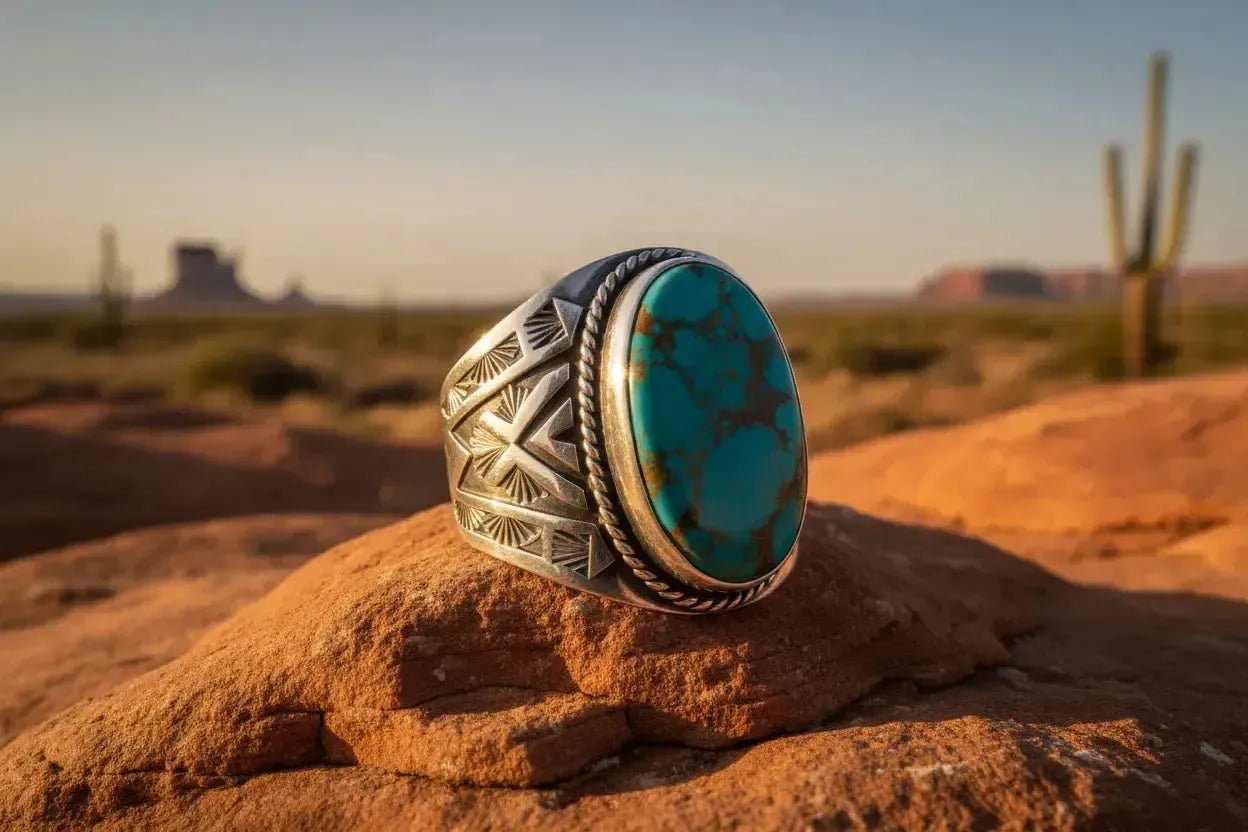
What immediately distinguishes Native American jewelry: the alliance of solid silver and turquoise. Turquoise – a sacred stone for many indigenous nations, a symbol of sky and water – set in .925 silver becomes the visual signature of an entire civilization.
Techniques that Revolutionized Jewelry Making
Repoussé Work
Navajo artisans master the art of hammering silver from the inside to create three-dimensional reliefs and patterns. This technique, applied to rings, bracelets, and necklaces, gives pieces a depth and presence impossible to achieve by casting.
Bezel Setting
Zuni artisans developed the "bezel" setting – a silver mount that completely surrounds the stone to protect it. This technique, now used worldwide, is an invention directly from the Native American tradition.
Zuni Inlay
The Zuni perfected the art of inlay: fragments of turquoise, carnelian, onyx, and mother-of-pearl are precisely cut and inlaid into silver to form complex geometric patterns. Work of extraordinary meticulousness.
Turquoise: The American Stone Par Excellence
It is impossible to talk about Native American jewelry without talking about turquoise. Mines in New Mexico, Arizona, and Nevada produce some of the most beautiful turquoises in the world – Sleeping Beauty, Kingman, Royston – each with its characteristic color and veins.
For the Navajo and Pueblo nations, turquoise is not just beautiful – it is sacred. It represents the connection between earth and sky, between human and divine. Wearing turquoise means wearing protection and intention.
This spiritual dimension of the stone largely contributed to its massive adoption in mainstream American culture – and now globally.
The Western Influence: When the Cowboy Adopts Silver
In the 19th and 20th centuries, American Western culture appropriated silver jewelry. Cowboys, ranchers, men of the West wore solid silver belt buckles, bison head rings, boots adorned with silver. Silver became the metal of the free man, of the man of the frontier.
This association – silver + masculinity + freedom – is deeply rooted in the American imagination. It partly explains why American men have such a natural relationship with silver jewelry, unlike some European cultures where masculine jewelry has long been taboo.
Squash Blossom: The Iconic Navajo Necklace
Among all the creations from this tradition, the "squash blossom" necklace holds a special place. Composed of silver beads alternating with stylized flower-shaped motifs and finished with a crescent-shaped pendant called a naja – itself inherited from Spanish and Moorish amulets introduced via colonial Mexico – this necklace perfectly illustrates how Navajo jewelry has absorbed external influences to create an entirely new language. The naja in particular has a fascinating history: its crescent shape dates back to Moorish ornamental traditions in Spain, transmitted to America via colonization, then reinterpreted by Navajo artisans into a symbol now perceived as deeply and authentically American.
From Reservation to National Market
The commercial turning point for Native American jewelry occurred at the turn of the 20th century, when railroad companies and the first tourist networks began to market these pieces to travelers from the East of the country. This meeting between traditional craftsmanship and the national market allowed generations of Navajo, Zuni, and Hopi artisans to make a living from their art, while raising the question, still debated today, of authenticity and fair compensation in the face of mass-produced imitations. This complex economic history is an integral part of what makes turquoise set in silver so rich in meaning: each authentic piece carries the weight of a permanent negotiation between tradition, economic survival, and cultural recognition.
The Heritage in Contemporary Jewelry
Today, Native American and Western influence can be found in thousands of jewelry collections around the world. Geometric patterns, natural stones set in silver, organic forms inspired by nature – all bear the imprint of this tradition.
At Vindicta, we select pieces of solid .925 silver that fit into this vision: jewelry with authentic natural stones – turquoise, onyx, carnelian – carefully set, that carry a story and an intention.
Not fashion jewelry. Character jewelry, inspired by millennia-old traditions, certified solid .925 silver. For over 10 years, this has been Vindicta's vision: making meaningful jewelry accessible – without compromise on quality or identity.
✦ Vindicta — Solid 925 silver
The piece that makes the difference
Certified 925 silver · Free shipping from €69 · 10 years of excellence
Discover our jewellery →