

925 Sterling Silver Eastern Star: Symbolism, History, and Men's Jewelry
The oriental star is one of the most powerful and widespread motifs in all of Islamic art. It can be found engraved on the walls of the Alhambra palaces, inlaid in the tiles of Ottoman mosques, woven into Persian carpets, carved into the wood of Fes madrasahs. And for centuries, it has adorned the silver jewelry of men and women in the Islamic world—a perfect geometric form that says something essential about the worldview of those who wear it.
What is the oriental star?
The term "oriental star" actually refers to a family of geometric shapes—star polygons with 6, 8, 10, or 12 points, constructed by the intersection of simple geometric shapes. The 8-pointed star—obtained by the intersection of two squares—is the most common in Islamic jewelry. The 6-pointed star, formed by two opposing triangles, is also very present, particularly in Maghrebi and Andalusian traditions.
These forms are not chosen at random. Islamic geometry is a sacred geometry—a way to represent the divine order of the world through mathematically perfect forms. The oriental star embodies this idea: a motif that can repeat infinitely without ever contradicting itself, an image of divine unity in the multiplicity of forms.
The star in Islamic jewelry through the ages
The first geometric stars appeared in Islamic art as early as the 8th century, under the Umayyads. But it was from the 11th century, with the rise of the Seljuk and Fatimid dynasties, that this motif became omnipresent in all decorative arts—architecture, ceramics, textiles, metallurgy, and jewelry.
Ottoman goldsmiths from the 15th to the 18th century brought this motif to its peak. Solid silver signet rings and seals adorned with 8-pointed stars were worn by dignitaries, merchants, and men of letters in the Ottoman Empire as signs of belonging to a civilization—an affirmation of identity as much as an ornament. In medieval Andalusia, the goldsmiths of Granada and Cordoba integrated the oriental star into compositions of dazzling complexity, blending geometric motifs, calligraphy, and floral arabesques.
The Geometer and the Artisan: How a Perfect Star is Constructed
The construction of an oriental star is anything but improvised: it follows a precise geometric method, transmitted from artisan to artisan for centuries, based solely on the compass and ruler—without a graduated measuring instrument. This technical constraint, inherited from the mathematicians of the Islamic Golden Age, explains the formal perfection of these motifs: every angle, every intersection is born from an exact ratio of proportions rather than an approximate measurement. Ottoman and Andalusian master artisans transmitted this geometric knowledge as an art in itself, distinct from the metalwork itself—some workshops even employed a specialized "tracer," whose sole task was to draw the motifs before the goldsmith engraved them in silver.
Wearing the oriental star today
For a man seeking a meaningful .925 silver jewel, the oriental star is a choice of exceptional richness. It conveys several things at once: belonging to a civilization, a taste for geometry and formal perfection, a connection to a long and profound history. And unlike other more explicitly religious symbols, the oriental star is a universal cultural motif—worn by Muslims and non-Muslims alike who recognize in this form a timeless mathematical beauty.
In men's jewelry, the oriental star is mainly featured in signet rings and pendants. A .925 silver signet ring engraved with an 8-pointed star is a sober and powerful piece—a jewel that doesn't shout but speaks to those who know how to listen. A solid silver oriental star pendant, worn on a delicate chain, is an elegant alternative for those who prefer discreet but meaningful jewelry.
The oriental star and other Islamic symbols
The oriental star is part of an ecosystem of Islamic symbols frequently found in jewelry. The Hand of Fatima is perhaps the best known, associated with protection against the evil eye. The crescent moon, a symbol of Islam since the Ottoman era, is often combined with the star in contemporary jewelry. Arabesques and calligraphy complete this symbolic universe where each form is a way of expressing one's worldview.
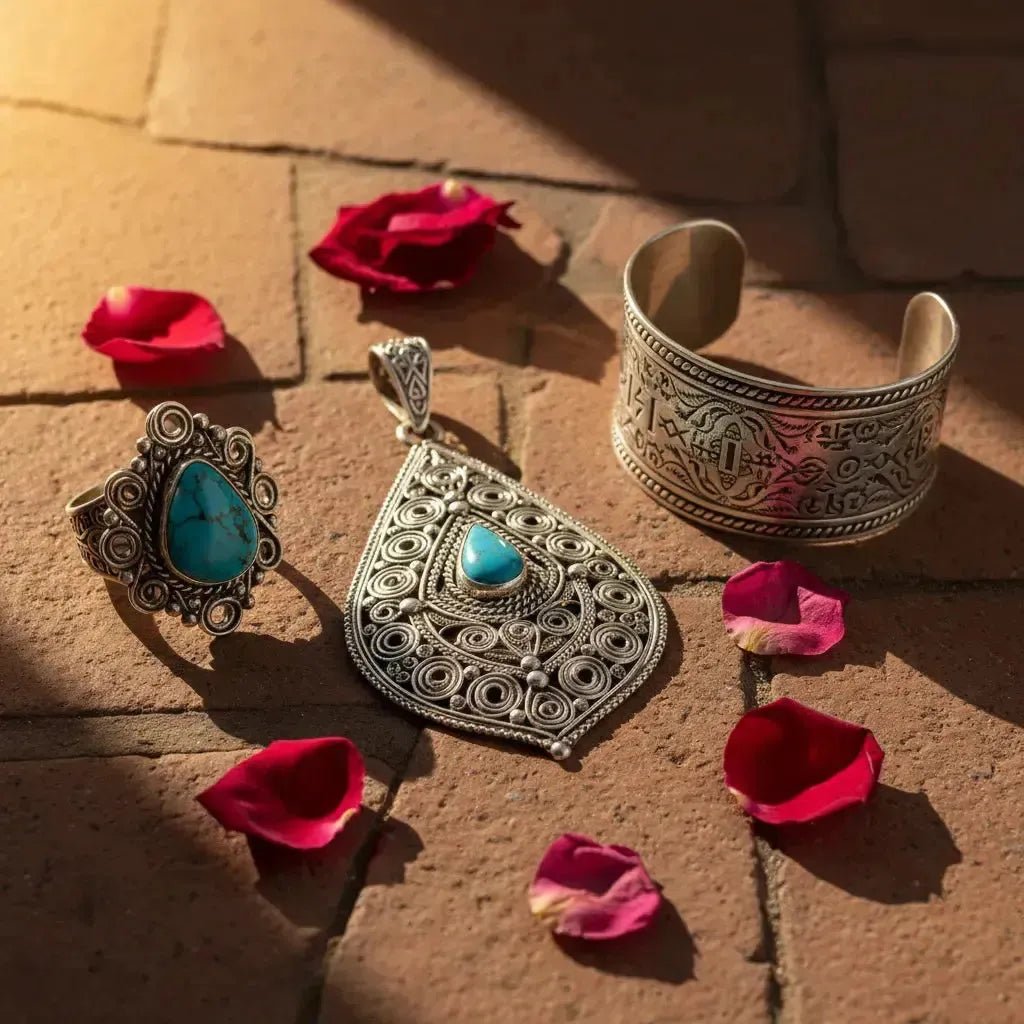
These symbols are not mutually exclusive—they complement each other. A man wearing an oriental star .925 silver signet ring can also wear a crescent bracelet or pendant—each piece adding a layer of meaning to a coherent ensemble. At Vindicta, we select men's .925 silver rings and jewelry with natural stones that fit into this rich symbolic universe.
✦ Vindicta — Solid 925 silver
The piece that makes the difference
Certified 925 silver · Free shipping from €69 · 10 years of excellence
Natural Stone Jewellery →




Leave a comment
This site is protected by hCaptcha and the hCaptcha Privacy Policy and Terms of Service apply.