Hanau, the historical capital of German silversmithing
There are cities whose names mean nothing to the general public, but which have profoundly shaped the history of a craft. Hanau is one of them. Located twenty kilometers east of Frankfurt, this Hessian city was for three centuries the nerve center of German silver smithing — and, by extension, one of the most influential centers of European silversmithing.
To understand Hanau is to understand how a city can become the cradle of expertise thanks to an accident of history: the massive arrival of French and Walloon Protestant refugees who brought with them their techniques, their tools, and their culture of precious metals.
1597: Refugees Who Founded a Tradition
It all begins with the Wars of Religion that tore through France and the Spanish Netherlands in the 16th century. Thousands of Protestants — French Huguenots and Walloon refugees — fled persecution and sought refuge in the Protestant territories of Germany. Count Philip Louis II of Hanau-Münzenberg offered them hospitality in 1597: he ceded them land east of the old city to found a new city, the Neustadt of Hanau.
Among these refugees were silversmiths, jewelers, embroiderers, weavers — highly skilled artisans who brought with them the techniques of Parisian, Antwerp, and Brussels workshops, then among the most advanced in Europe. In a few decades, the Neustadt of Hanau became an exceptional craft center.
It is this cultural grafting — French and Flemish savoir-faire transplanted to German soil — that gave Hanau's silversmithing its hybrid character and its particular quality. Hanau silversmiths did not copy existing German models: they brought a new, finer, more decorative sensibility, influenced by the French taste for ornamentation and precision of line.
The 18th Century: The Golden Age of Hanau Silverware
In the 18th century, Hanau became one of the most productive silversmithing cities in Europe. Its workshops exported throughout Germany, to princely courts, to wealthy bourgeois families who wanted silver tableware, cutlery, snuff boxes, candlesticks, and parures.
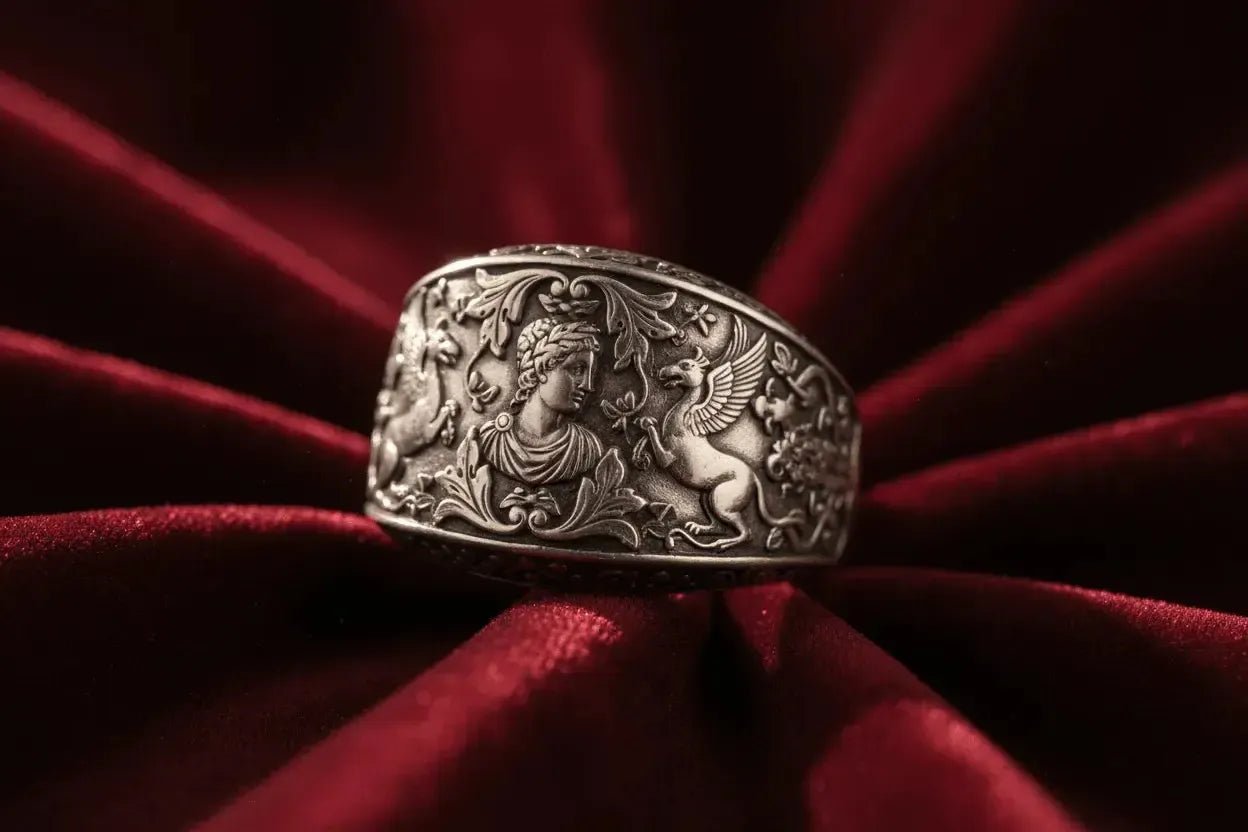
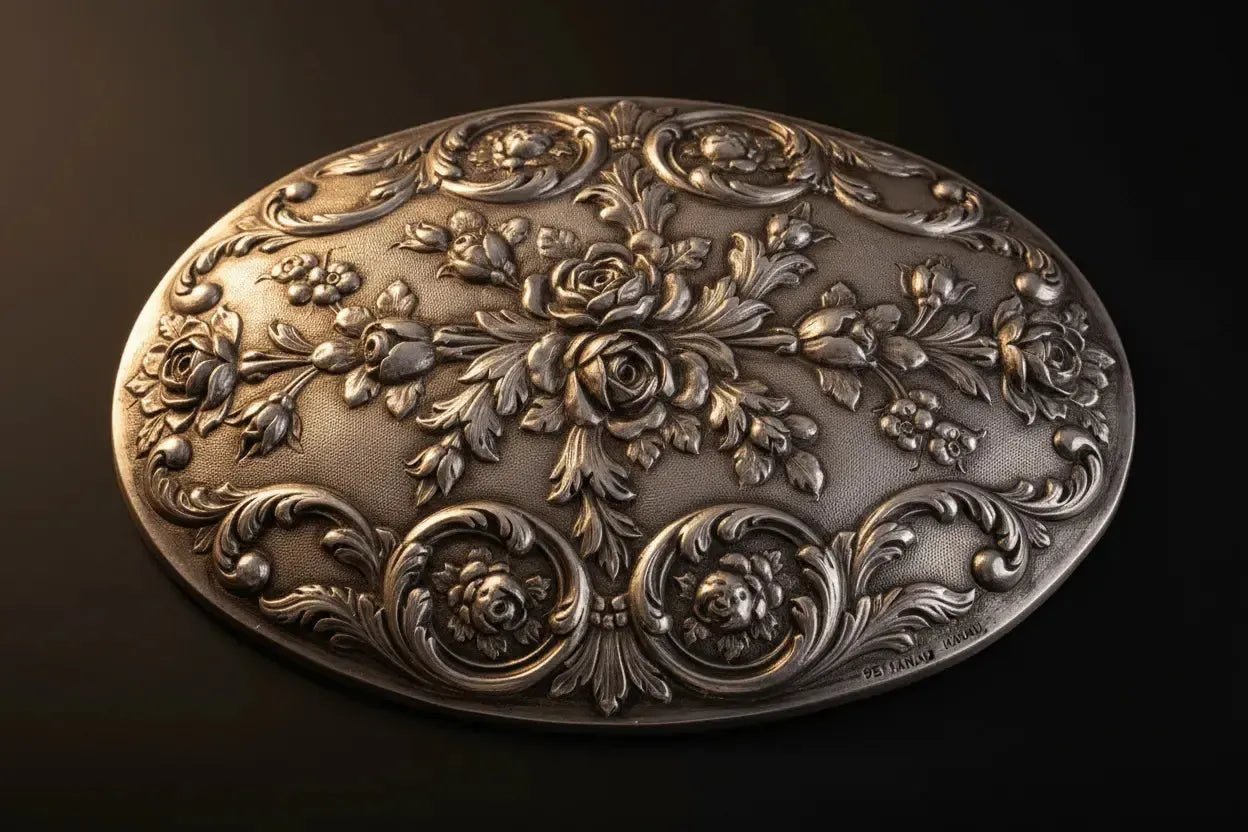
Hanau's specialty was repoussé work — a technique that involves hammering silver from the inside to raise relief patterns on the outside surface. Hanau silversmiths excelled in figurative scenes, complex floral motifs, and intertwined borders. Their pieces are recognizable by their decorative density and the finesse of their execution.
The city also developed a high-quality copy industry: pieces inspired by great European styles — Baroque, Rococo, Renaissance — produced in series but with real artisanal care. This positioning — artisanal quality at industrial volume — anticipated by two centuries what the jewelry industry is still trying to achieve today.
The School of Applied Arts and the Transmission of Knowledge
In 1772, the Landgrave of Hesse-Kassel founded the Zeichenakademie in Hanau, the drawing school that would become one of the most important schools of applied arts in Germany. Its objective was explicit: to train artisans capable of designing and executing jewelry, silverware, and decorative objects at the highest level.
This school — which still exists today under the name Hochschule für Gestaltung Offenbach after several mergers and relocations — has trained generations of silversmiths, jewelers, and designers. It has contributed to making the Rhine-Main region one of the world's centers for contemporary jewelry, with Frankfurt as a financial hub and Hanau as a technical cradle.
Today, Hanau is still home to the Deutsches Goldschmiedehaus — the German Goldsmiths' House — a museum and exhibition center dedicated to the art of jewelry and silverware. It is there that some of the most beautiful pieces produced by the city's workshops since the 17th century are preserved.
The Brothers Grimm, Another Pride of Hanau
Hanau is not only the city of silverware: it is also the birthplace of Jacob and Wilhelm Grimm, born in 1785 and 1786 respectively. This geographical coincidence is not entirely fortuitous: the same culture of artisanal transmission and meticulous craftsmanship that made Hanau's silversmiths famous also nurtured the meticulous spirit of the two brothers, who spent years collecting and precisely transcribing German folk tales. Today, the statue of the Brothers Grimm stands on Hanau's market square, a few steps from the silversmith workshops that still perpetuate, on a smaller scale, the 17th-century tradition.
Hanau's Legacy in Contemporary Silversmithing
What Hanau transmitted to European silversmithing is a conviction: artisanal quality and large-scale production are not incompatible, provided that technical mastery is never sacrificed on the altar of speed. Hanau silversmiths worked quickly — they had to supply a demanding market — but they worked well, because their reputation was their only capital.
This demand is found in every solid 925 silver jewel that comes out of a reputable workshop: the choice of certified metal, the precision of the finish, the attention to details that no one will see except the wearer of the jewel. At Vindicta, we share this heritage: our 925 silver rings and our sculpted jewelry are designed with the same conviction that Hanau silversmiths held three centuries ago — that the beauty of a jewel is measured by how it withstands time, not by how it shines on the day of purchase.
✦ Vindicta — Solid 925 silver
The piece that makes the difference
Certified 925 silver · Free shipping from €69 · 10 years of excellence
Discover our jewellery →