The Lithuanian silver cross: when Baltic craftsmanship defies time
In Lithuania, there are hills covered with crosses. Tens of thousands of crosses made of wood, wrought iron, and silver—planted by generations of Lithuanians as acts of faith, resistance, and memory. The Hill of Crosses, near Šiauliai, is a UNESCO World Heritage Site. It is also the most powerful symbol of a craft tradition that made the silver cross the central object of Lithuanian goldsmithing for six centuries.
It is no coincidence that Lithuania, the last country in Europe to officially convert to Christianity (1387), developed such an intense relationship with the cross as a crafted object. The late conversion created a unique creative tension: Christian motifs engraved in silver worked using pagan Baltic techniques, new forms born from the blend of two traditions that had not yet met.
Silver in Baltic Culture: Long Before Christianity
Silver was present in the Baltic region long before the arrival of Christianity. Archaeological excavations in Lithuania, Latvia, and Estonia have unearthed silver jewelry dating from the 1st to the 12th century: spiral fibulae, bracelets with snake-head ends, pendant necklaces, and rings with geometric motifs.
These jewels demonstrate remarkable technical mastery—particularly the granulation technique, which involves soldering tiny silver beads onto a surface to create embossed patterns without engraving tools. This technique, shared with Viking and Slavic goldsmiths, achieved a particular fineness in the Baltic countries: the grains are so small and so regularly spaced that they resemble fabric more than metal.
The motifs of this pagan Baltic goldsmithing are geometric and cosmological: the sun, the moon, the stars, snakes, horses. These symbols did not disappear with Christianization—they merged into new Christian motifs, creating a hybrid visual vocabulary that is the hallmark of Lithuanian goldsmithing.The Lithuanian Cross: One Form, a Thousand Variations
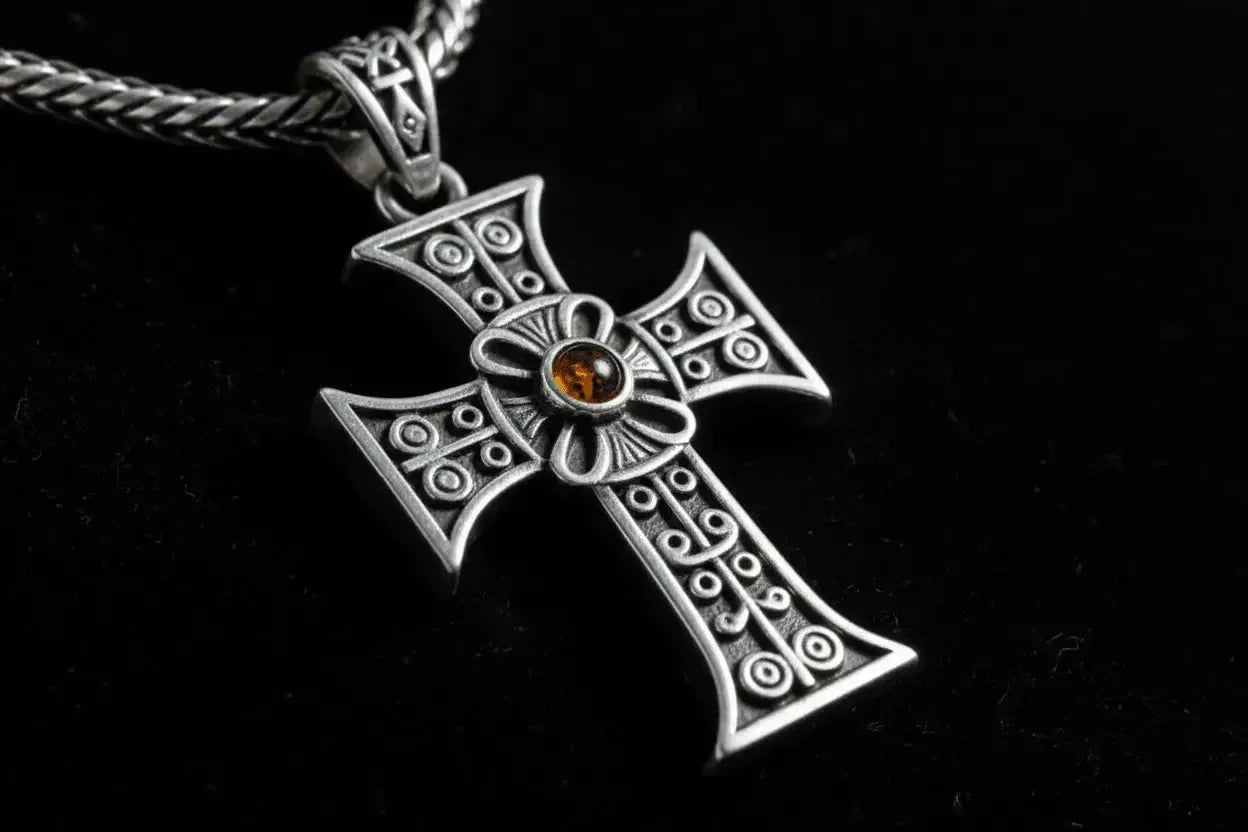
The Lithuanian silver cross is not a standard Latin cross. It is recognizable by its flared ends, its arms often adorned with solar or floral motifs, and its surface worked in repoussé or filigree. Each region of Lithuania has developed its own variations: the Suvalkija cross is more austere, that of Žemaitija more elaborate, and that of Aukstaitija more delicate.
What unites all these variations is the presence of pagan motifs integrated into the Christian structure. An eight-pointed sun at the center of the cross. Snakes coiled around the arms. Motifs of rue leaves—the rūta, a sacred Lithuanian plant—running along the edges. These elements are not decorations added later: they have been part of the formal grammar of the Lithuanian cross since the 15th century.
The artisans who make these crosses—called kryždirbiai in Lithuanian—are recognized specialists in their communities. Their know-how is passed down within families, from father to son or from master to apprentice, with jealously guarded pattern books. UNESCO inscribed the art of kryždirbiai on the Representative List of the Intangible Cultural Heritage of Humanity in 2001.Resistance Through Craftsmanship
The Hill of Crosses is not just a place of piety. It is a place of resistance. During the Soviet occupation (1940-1990), authorities attempted three times to raze the hill with bulldozers. Each time, Lithuanians replanted crosses in the days that followed—more numerous than before. The hill became a symbol of Lithuanian national identity, of passive resistance to cultural erasure.
This political dimension of Lithuanian silver craftsmanship is insistent. Wearing a Lithuanian silver cross is to wear a sign of belonging to a culture that survived centuries of occupation—Russian, German, Soviet—by preserving its artisanal forms as an act of collective memory.A Pilgrimage That Has Become a Contemporary Ritual
Even today, placing a cross on the hill near Šiauliai remains a gesture practiced by thousands of Lithuanians and visitors each year, on the occasion of a wedding, a bereavement, an important anniversary, or simply a visit to the region. Pope John Paul II himself visited in 1993, just a few years after the country regained its independence, further strengthening the spiritual and symbolic dimension of the place. This living ritual—a cross placed, a prayer said, a gesture repeated for generations—illustrates how Baltic craftsmanship has never remained a museum curiosity: it continues to carry meaning in the daily lives of Lithuanians.
The Baltic Heritage in Contemporary Jewelry
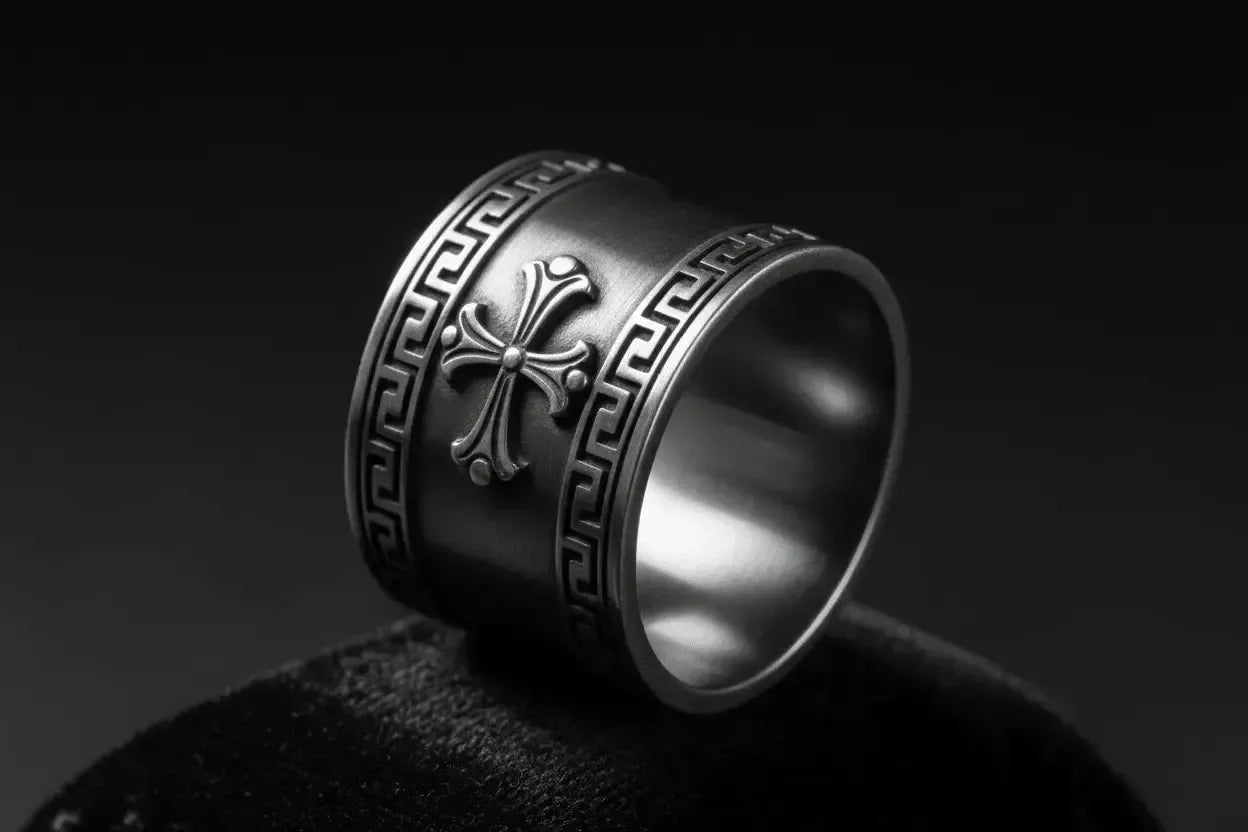
The motifs of Baltic goldsmithing—fine granulation, geometric interlacing, solar symbols—are currently experiencing renewed interest in contemporary European jewelry. Their rigorous geometry and symbolic charge make them motifs that work as well on a contemporary 925 silver ring as on a traditional cross.
What makes these motifs enduring is their internal logic: they are not arbitrary. Each form has a meaning, each repetition a rhythm. A piece of solid 925 silver jewelry inspired by this tradition does not quote the past—it is part of a formal continuity that transcends eras. This is the strength of Baltic craftsmanship: having created a visual language solid enough to cross six centuries without losing its relevance.
✦ Vindicta — Solid 925 silver
The piece that makes the difference
Certified 925 silver · Free shipping from €69 · 10 years of excellence
Discover our jewellery →