Algerian 925 Silver Jewelry: Heritage, Craftsmanship, and Identity
Algeria is one of the countries where silver has most deeply marked the history of jewelry. From the Kabylie mountains to the Tell plains, from the Sahara oases to the coastal cities of Oran and Annaba, each region has developed its own aesthetic codes, its own techniques, its own symbols. Understanding Algerian silver jewelry is understanding an entire civilization — its beliefs, its migrations, its resistance, its beauty.
The Berbers, Algeria's first goldsmiths
Before the Arabs, before the Ottomans, before the French, there were the Berbers. These indigenous peoples of the Maghreb developed a tradition of goldsmithing among the richest in the Mediterranean world, based on solid silver, natural stones, and geometric patterns charged with meaning. Silver was not just a precious metal — it was a protective metal, associated with the moon, femininity, and baraka.
Algerian Berber jewelry is recognizable by its architecture: voluminous pieces, built like miniature structures, where every element has a symbolic function. Fibulae — those large brooches that fastened women's clothing — are perhaps the most iconic pieces. Worn in pairs on the shoulders, connected by a chain, they signaled social status, region of origin, and tribal affiliation. A Kabyle woman and a Tuareg woman did not wear the same fibulae — and an expert eye could read an entire human geography in these jewels.
Tlemcen, Algiers, Constantine: three capitals of silver
Ottoman Algeria produced some of the most refined silver jewelry in the Islamic world. Tlemcen, the former capital of the Zianid kingdom and a crossroads between Andalusia and the Maghreb, developed goldsmithing of exceptional finesse — delicate filigree, translucent enamels, and floral motifs inherited from Hispano-Moresque art. Tlemcen jewelry carries the echo of Granada and Cordoba, that lost Andalusia whose refugee artisans brought their expertise to the Maghreb after the Reconquista.
Ottoman Algiers, meanwhile, was a center for the production of elaborate feminine finery — tiaras, multi-row necklaces, and wide bracelets in nielloed silver. These pieces, worn during weddings and major celebrations, testify to remarkable technical mastery and a keen sense of staging for the female body. Constantine, finally, is renowned for its jewelry mixing gold and silver, its crescent-shaped pendants, and its monumental earrings that framed the face like a painting.
The stones of Algerian jewelry
Traditional Algerian jewelry cannot be conceived without its stones. Red Mediterranean coral is the signature stone of the Maghreb — it is found in almost all traditional finery, from Kabyle fibulae to Oran necklaces. It is associated with protection, fertility, and life. Yellow amber, imported for centuries via trans-Saharan routes, brings its golden warmth to the most precious compositions.
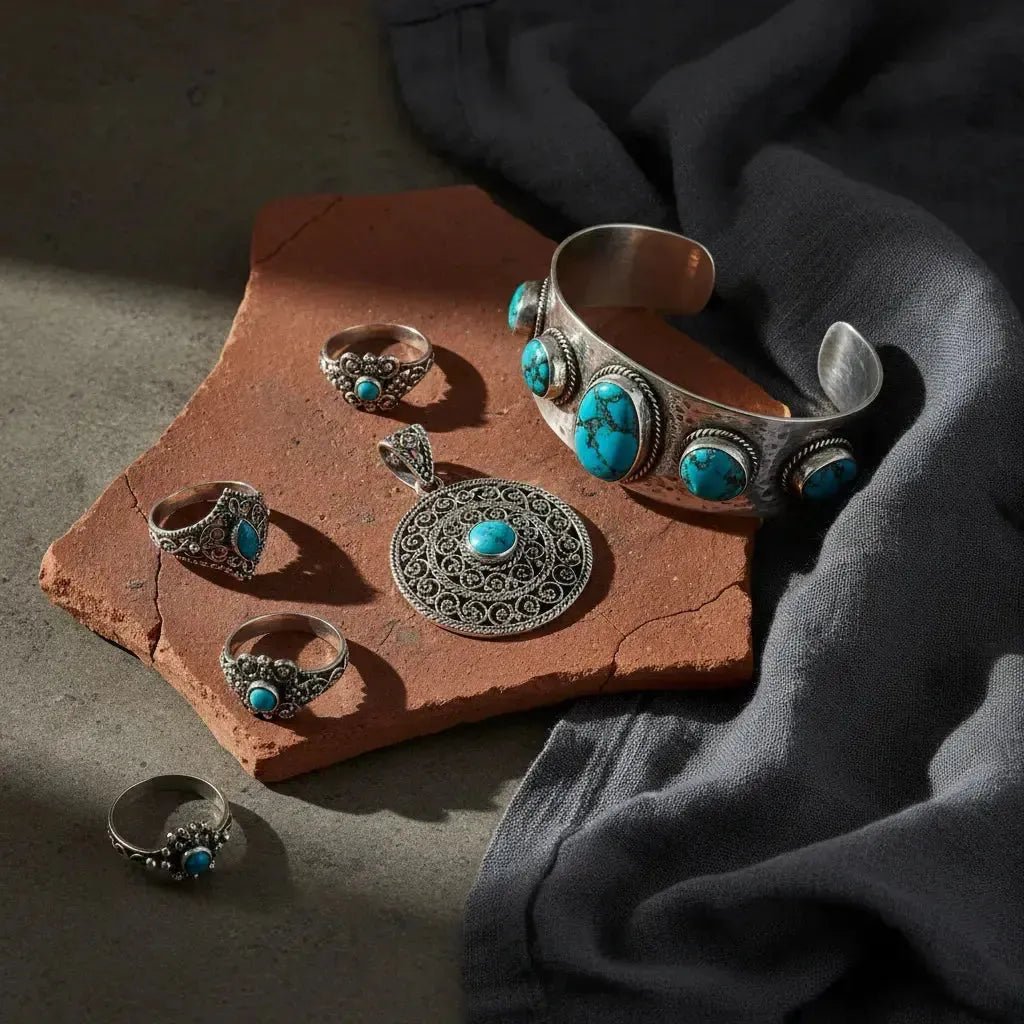
The carnelian, the Prophet's stone, is omnipresent in men's jewelry — rings, signet rings, seals. Black onyx, turquoise, and red garnet complete this palette of natural stones that give Algerian jewelry its very distinct character: a chromatic richness that contrasts with the cold luster of solid silver to create pieces of striking beauty.
Traditional Costume, the Jewel's Setting
Great Algerian parures can only be fully understood when associated with their original costume. The Algiers karakou, a velvet jacket embroidered with gold thread, called for short, structured jewelry placed on the collar. The Kabyle costume, looser, allowed instead for the wearing of voluminous fibulae and long necklaces that accompanied the movement of the fabric. This relationship between garment and jewel was never left to chance: each region had calibrated the size and weight of pieces over generations to the precise cut of its costume, so that the jewelry complements the silhouette rather than overwhelming it.
A living heritage
Algerian jewelry is not a dead art. It lives on in the workshops of the medinas, in the markets of Ghardaïa and Béjaïa, in the hands of artisans who pass their techniques from father to son, from mother to daughter. It also reinvents itself — contemporary designers are seizing these ancestral codes to translate them into a modern, accessible language, worn by a new generation proud of its roots.
Wearing a 925 silver jewel inspired by this tradition is to participate in this continuity. It is not nostalgia — it is an affirmation of identity, an assumed aesthetic and cultural choice. At Vindicta, we select pieces that honor this heritage: certified 925 silver, authentic natural stones, and rigorous craftsmanship. To delve deeper into regional traditions, consult our file Tlemcen, Kabylie and the soul of solid silver. Also discover our selection of 925 silver jewelry with natural stones.
✦ Vindicta — Solid 925 silver
The piece that makes the difference
Certified 925 silver · Free shipping from €69 · 10 years of excellence
Oriental 925 Silver Jewellery →