
Article: Wallada bint al-Mustakfi: The Poetess-Princess Who Made Jewelry Her Voice
Wallada bint al-Mustakfi: The Poetess-Princess Who Made Jewelry Her Voice
Wallada bint al-Mustakfi: The Princess Who Defied Cordovan Conventions
In the history of Muslim Spain, no female figure better embodies intellectual daring and aesthetic refinement than Wallada bint al-Mustakfi. Daughter of the Umayyad caliph of Cordoba al-Mustakfi, she was born in the 11th century into a court already renowned for its splendor. However, it was through her own merits—her poetry, her literary salon, her declared taste for luxury—that she entered Andalusian legend, far beyond her simple status as a crown princess.
A Literary Salon Open to Women and Men
Upon her father's death, Wallada refused the traditional veil and inherited a considerable fortune, which she used to establish one of Cordoba's most popular literary salons. Contrary to the customs of her time, she welcomed poets and intellectuals without distinction of gender, personally mentoring young female poets in her art. This salon became a major cultural hub in 11th-century Al-Andalus, frequented by calligraphers, musicians, and jewelers—the same artisans who perpetuated the techniques of Andalusian filigree still found today in jewelry inspired by that period.
A Poet Who Embroidered Her Verses on Her Own Clothes
Wallada became famous for a unique habit: she had verses of her own composition embroidered directly onto the sleeves of her dresses, transforming the garment itself into a poetic medium and a public declaration of independence. This practice, which scandalized as much as it fascinated Cordovan society at the time, demonstrates a very particular relationship with ornamentation—for her, clothing and jewelry were never mere accessories, but means of personal expression as powerful as writing itself. This philosophy resonates directly with the spirit of our women's 925 silver necklaces and our Andalusian earrings, conceived as pieces that speak for themselves, rather than as simple discrete complements to an outfit.
Ibn Zaydun and the Most Famous Poetic Correspondence in Al-Andalus
The tumultuous relationship between Wallada and the poet Ibn Zaydun, punctuated by verses of love and then public rupture, remains one of the most commented episodes in Andalusian literature. Their poetic exchanges, where each responded to the other in increasingly sharp verses, have traversed centuries and are still studied today as a pinnacle of Arab-Andalusian poetry. This freedom of public speech, rare for a woman of her rank at the time, was accompanied by an assumed taste for sumptuous jewelry and adornments—garnet-set rings, multiple necklaces, stacked bracelets—which contemporary chronicles describe in detail as signs of her status as much as her assertive personality.
Granada Garnet and Turquoise, Stones of a Refined Court
The Umayyad court of Cordoba, like that of Granada which succeeded it, cultivated a marked taste for colored stones set in silver—a legacy found in our article on the Granada garnet. Andalusian noblewomen, like Wallada, wore jewelry that openly displayed their social rank and financial independence—a relationship with jewelry very different from the discretion that would later characterize certain periods of European history. Our women's 925 silver rings set with natural stones are directly in line with this tradition of jewelry assumed as a statement rather than a simple discreet ornament.
An Icon Rediscovered by Contemporary Spain
Long relegated to a footnote in general histories of Al-Andalus, Wallada bint al-Mustakfi has undergone a true rediscovery in Spain and the Arab world over the past few decades. Streets in Cordoba, her birthplace, now bear her name, and her verses are studied in Arab-Andalusian literature curricula as an early and rare example of public female affirmation in an otherwise highly codified society. This recent historical rehabilitation illustrates a broader movement to re-examine Andalusian heritage, seeking to place female figures in the place they actually occupied in the cultural life of the time, rather than confining them to secondary roles in traditional dynastic narratives.
Jewelry as a Personal Signature, Then and Now
What truly distinguishes Wallada in Andalusian history is this conviction that appearance—clothing embroidered with verses, carefully chosen jewelry, a confident public demeanor—could be a political and artistic act in itself, not just a passive sign of social status. This idea directly underpins our approach to contemporary Andalusian jewelry: every piece selected at Vindicta, from necklaces to earrings to rings, is conceived as a personal signature rather than an interchangeable accessory—the direct legacy of a court where women already knew, a thousand years ago, that adornment could be a voice.
A Legacy of Literate Women Too Often Erased
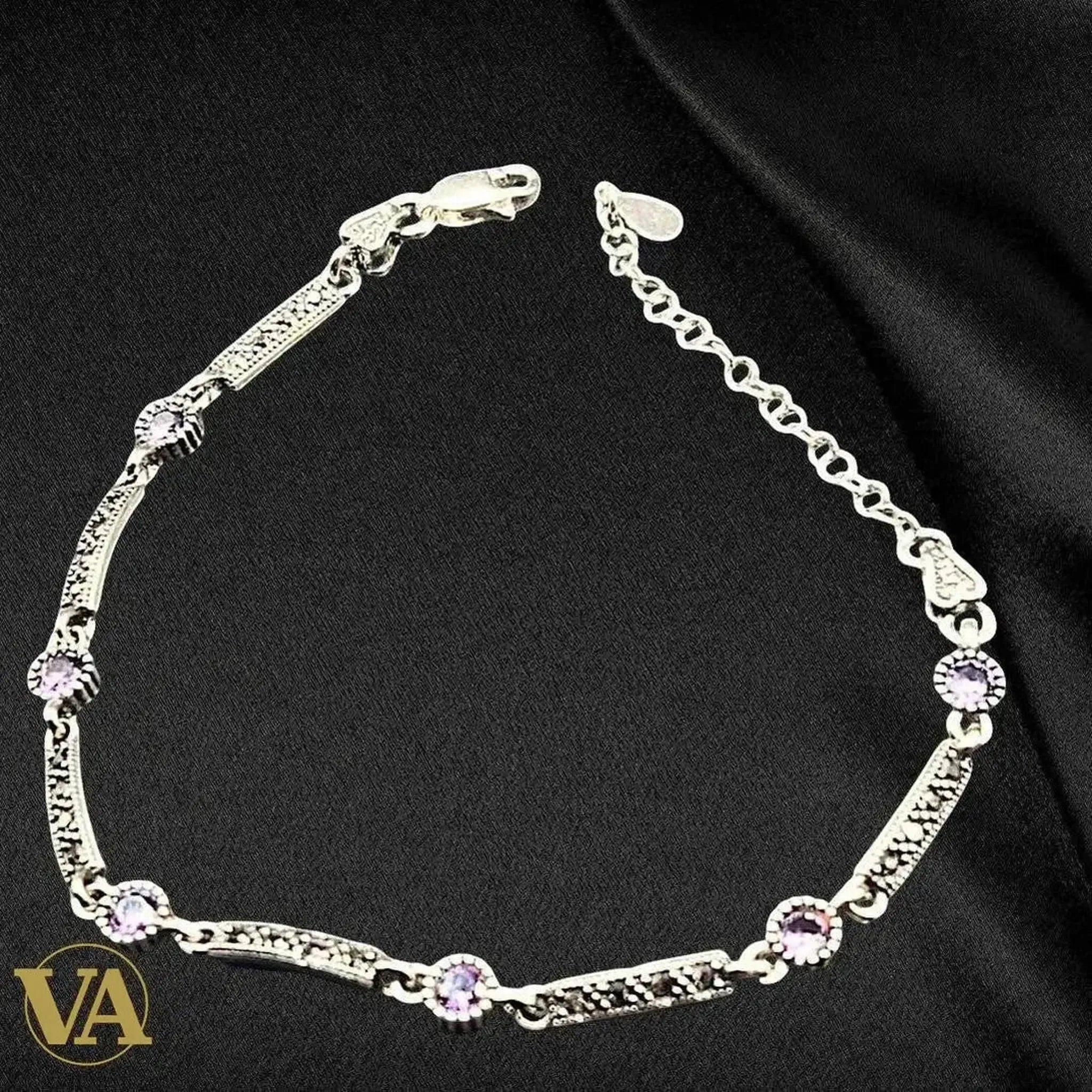
Wallada was not an isolated exception: 10th and 11th-century Al-Andalus saw the emergence of several influential female poets and women of letters, whose names have often been relegated to the background of narratives centered on caliphs and military conquests. Rediscovering this history means understanding that Andalusian aesthetic refinement—the very thing that inspires our women's 925 silver bracelets with patterns inspired by the Alhambra mosaics today—owes as much to these women as to the caliphs whose names history more readily remembers.
✦ Vindicta — Solid 925 silver
The piece that makes the difference
Certified 925 silver · Free shipping from €69 · 10 years of excellence
Women's 925 Silver Rings →


