Persian Turquoise: Sacred Stone of Protection and Wisdom
Persian horsemen traditionally tied a turquoise to their horse's harness before a long journey. The belief was that if the animal were to fall, the stone would break in its place—sacrificed to spare the rider. However naive it may be, this legend says something profound about the status of turquoise in Persia: a stone never worn for appearance, but for protection.
Five Thousand Years of Mining in Nishapur
Iran is home to the oldest known turquoise mines in the world, exploited for five millennia in Nishapur, in the northeast of the country, at the foot of an extinct volcano whose ancient geological activity colored the surrounding rock. Persian turquoise—intense, uniform sky blue, without black veins—remains the absolute reference in jewelry today, so rare it is compared to matrix turquoise, crossed by more common brown or black natural veins. Achaemenid kings Cyrus and Darius inlaid their thrones, palaces, and the site of Persepolis itself with it—wearing turquoise then meant displaying direct affiliation with the sphere of imperial power. The Nishapur mines operated continuously until the 20th century, a record of mining continuity rarely equaled in history.
The Stone That Warns of Danger
Another widespread legend in Persia is that turquoise changes color to warn its wearer of imminent danger—if it pales, it is a sign of an impending illness or accident. Persians saw it as a piece of sky fallen to earth, a gift from the gods to protect humanity. This protective dimension explains why turquoise, more than any other blue stone, spread so widely along the Silk Road, carried by caravans as a talisman against the dangers of the journey. Marco Polo himself, in his accounts of his travels in the 13th century, notes that Persian merchants sometimes sewed small fragments of it into the harnesses of their pack animals, a practice that has endured through the centuries in one form or another.
Wisdom, Sincerity, Friendship
Beyond protection, turquoise is traditionally associated with wisdom and truth—it was the stone offered to sages and philosophers. Its celestial blue evoked spirituality and divine connection, the stone that symbolically links earth to sky. Offering a turquoise was also a gesture of sincere friendship and loyalty, a custom still alive in some regions of the Middle East today. Lithotherapy traditions associate it with the throat chakra, supposedly promoting clarity in communication—although these virtues are not scientifically proven.
A Fragile Stone, To Be Handled With Care
Unlike onyx or carnelian, turquoise is relatively soft (5 to 6 on the Mohs scale) and, above all, porous: it absorbs moisture and can discolor irreversibly with prolonged contact with water, perfumes, or direct heat. Persian jewelers had developed a unique practice to stabilize it: soaking the raw stone in a thin layer of natural wax, an ancient technique that foreshadows the stabilization treatments used today in gemology. A simple soft, dry cloth is sufficient for its routine maintenance—avoid immersion, chemicals, and prolonged exposure to sunlight, which can alter its hue over the years.
Turquoise and Marcasite, a Persian Alliance
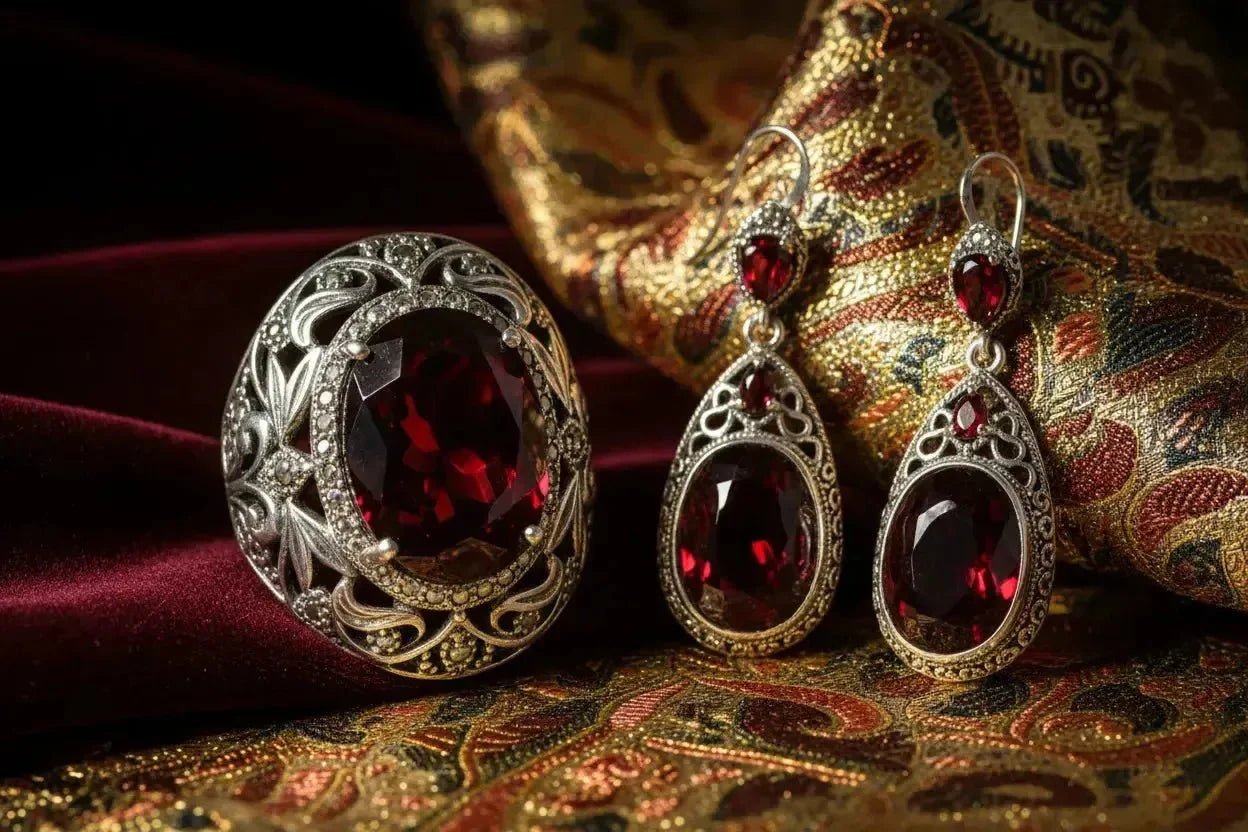
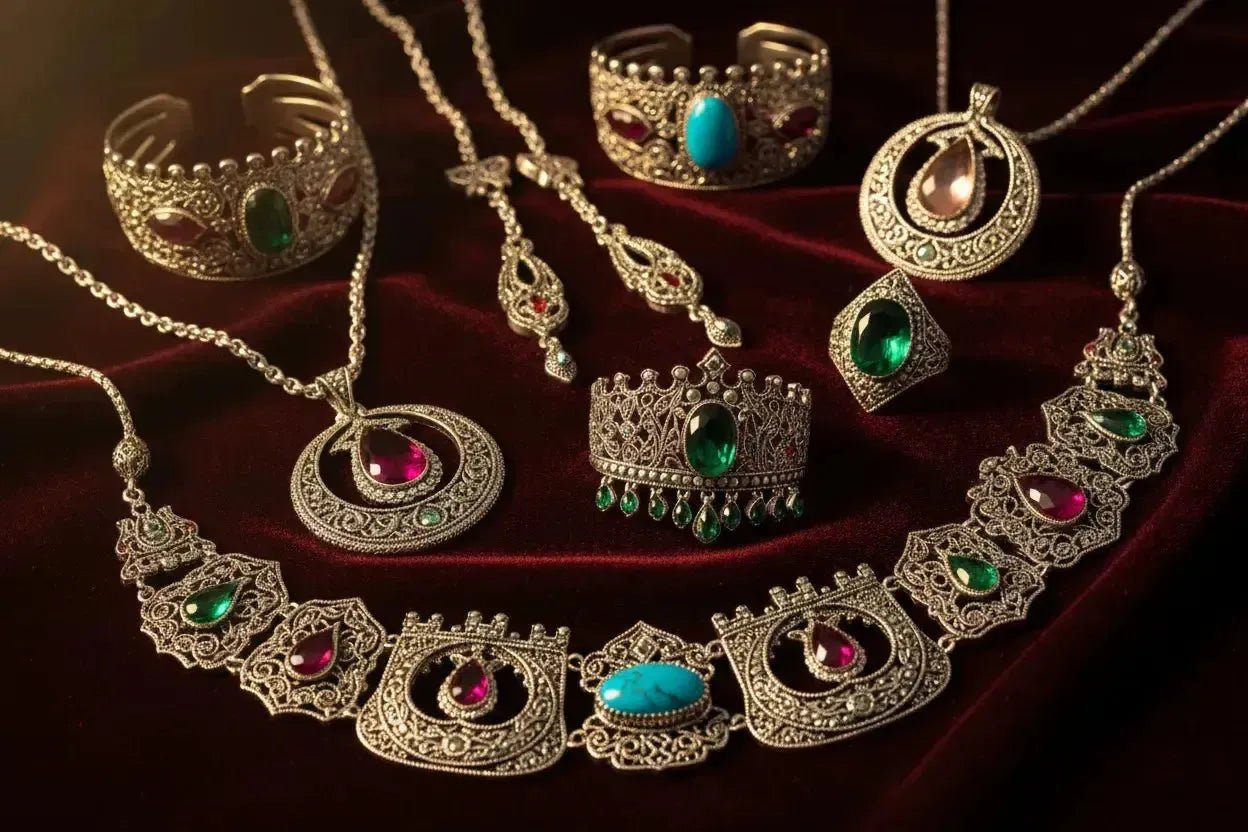
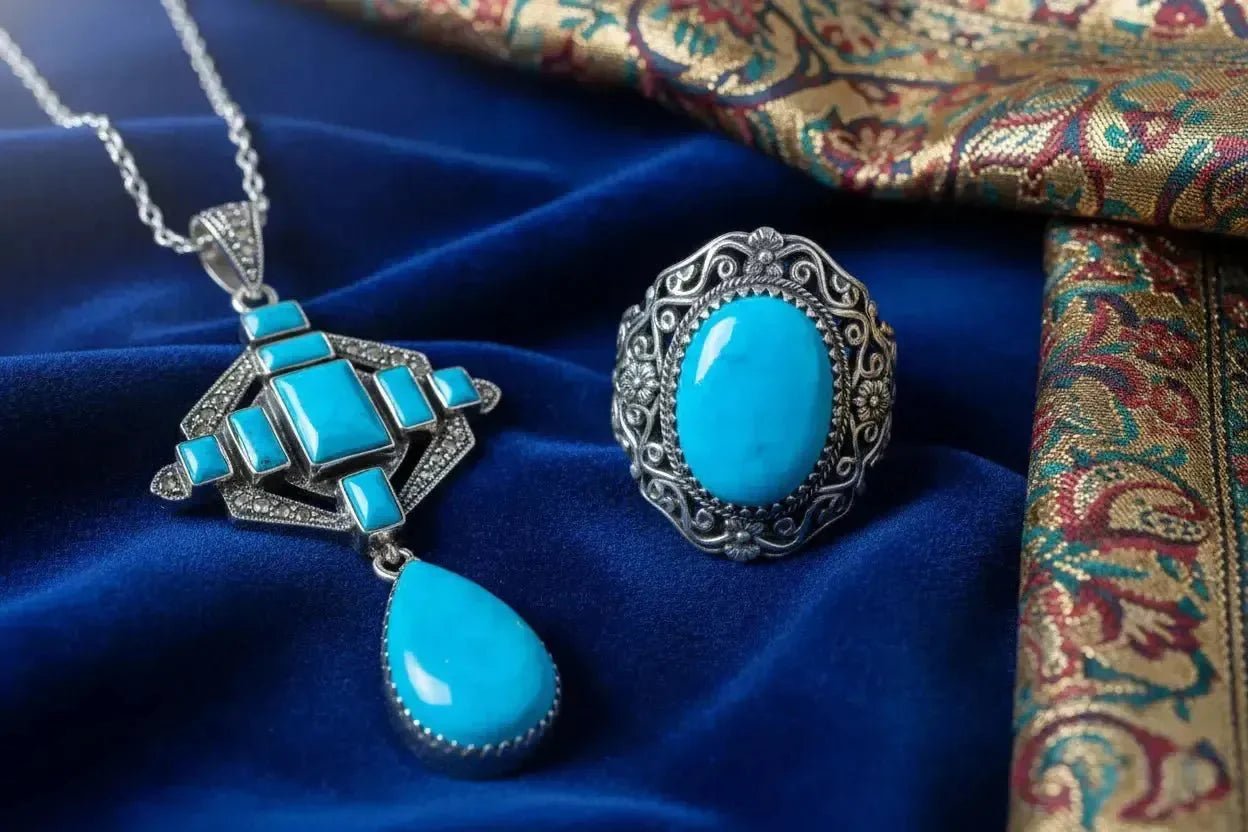
The association of turquoise with marcasite is one of the most recognizable signatures of oriental carved jewelry—celestial blue against metallic gray brilliance, a harmony that directly recalls great Art Deco pieces. It is also naturally associated with onyx—blue and black, sky and earth—with carnelian—blue and orange, water and desert—or with garnet—blue and red, sky and fire. Each of these associations is not arbitrary: it reinterprets, on the scale of a piece of jewelry, the great elemental contrasts of the Persian imagination.
American Turquoise, a Later Cousin
While Persia remains the historical reference, the American Southwest—Arizona, New Mexico—developed its own tradition of turquoise, worn by the Navajo and Zuni peoples long before European colonization. The two traditions were completely unaware of each other's existence, yet they led to almost identical symbolisms: protection, sky, wisdom. A convergence that is no coincidence—it undoubtedly stems from the color itself, whose evocation of sky and water seems to speak a universal language, independent of cultural boundaries.
How to Distinguish Real Persian Turquoise
In today's market, the rarity of authentic Persian turquoise makes it a frequent target for imitations—reconstituted, dyed turquoise, or simple resin imitation. A few simple benchmarks: real turquoise has a cool temperature to the touch that gradually warms up upon contact with the skin, unlike plastic which remains at a constant ambient temperature; its surface, even polished, retains a slight natural irregularity absent from perfectly smooth imitations.
Wearing Turquoise Today
Worn as a men's turquoise signet ring or a women's ring, turquoise retains that same immediate effect: a blue that needs nothing else to catch the eye, just as it caught the eye of Persian kings five thousand years ago.
✦ Vindicta — Solid 925 silver
The piece that makes the difference
Certified 925 silver · Free shipping from €69 · 10 years of excellence
Oriental 925 Silver Jewellery →