Potosí: The Silver Mountain that Changed the World
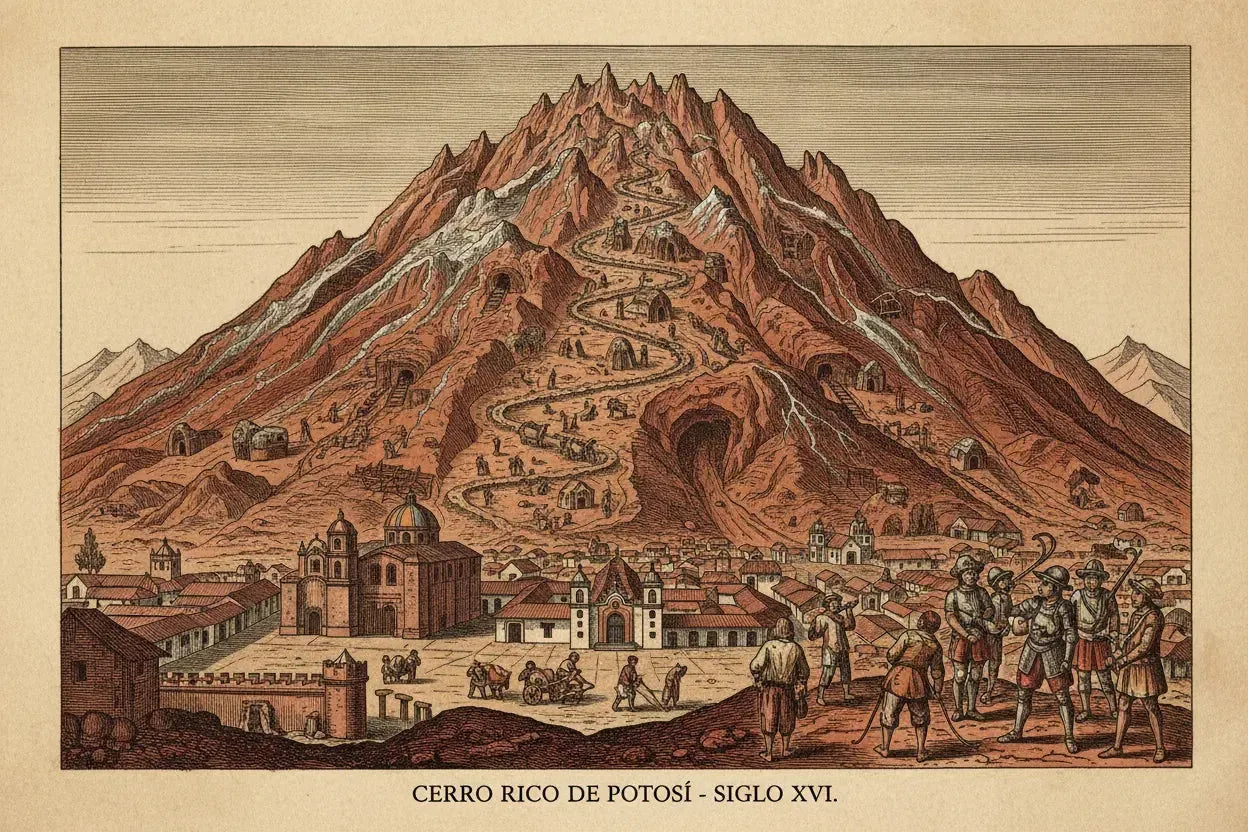
In 1545, indigenous shepherds discovered a mountain in Bolivia whose depths were teeming with silver. Potosí became the richest city in the world, producing 80% of the world's silver for two centuries and forever transforming the global economy — and jewelry along with it.
To place Potosí in the chronology of silver: The History of 925 Silver from Antiquity to Today. And for the colonial context: The Colonial Era — New World Silver and Cultural Influences.
The Discovery — 1545
On April 1, 1545, an indigenous shepherd named Diego Huallpa lit a fire on the slopes of Cerro Rico ("the rich mountain") to warm himself. The next morning, he discovered that the fire had melted pure silver that had flowed down the rock. The news spread like wildfire.
Within weeks, thousands of people flocked to Cerro Rico. Within years, Potosí — located at 4090 meters above sea level in the Bolivian Andes — became the largest city in the Americas and one of the largest in the world.
Staggering Figures
- Population: 160,000 inhabitants in 1650 — more than London or Paris at the time
- Production: More than 45,000 tons of silver extracted between 1545 and 1800
- Global Share: 80% of the world's silver produced in Potosí in the 16th century
- Price Impact: The price of silver in Europe fell by 50% between 1550 and 1650
- Expression: “Vale un Potosí” (worth a Potosí) — Spanish expression for immense wealth, still used today
Impact on the Global Economy
The Price Revolution
The massive influx of American silver caused the first global inflation in modern history. Prices in Europe doubled or tripled between 1550 and 1650. Economists call this phenomenon the "Price Revolution" — the first example of economic globalization.
The First Global Monetary System
Potosí's silver circulated worldwide. Via the Manila Galleon (Philippines), it reached China, which used it as currency. This was the first truly global monetary system in history.
The Democratization of Silver
Before Potosí, silver was reserved for the elites. Afterwards, it became accessible to European middle classes. Silver jewelry became democratized — paving the way for the standardization of 925 in the 19th century: 19th Century — Standardization of 925 Silver.
The Human Cost
Potosí's wealth came at an enormous human cost. Millions of indigenous workers and African slaves perished in the mines. The "mita" — forced labor imposed by the Spanish — decimated Andean populations. It is estimated that 8 million people died in Potosí between 1545 and 1825.
The Artistic Legacy
Potosí's silver financed the greatest artistic achievements of the European Renaissance and Baroque. Spanish churches, royal palaces, silverware from great courts — all were financed by Bolivian silver. To discover Renaissance goldsmithing: The Renaissance — The Golden Age of Goldsmithing.
Potosí Today
Cerro Rico is still exploited today — by cooperatives of Bolivian miners. The mountain has been a UNESCO World Heritage site since 1987. But it is slowly collapsing — emptied of its entrails after 500 years of exploitation.
Chronological Sequence
- Before: The Renaissance — The Golden Age of Goldsmithing
- Before: The Colonial Era — New World Silver
- Next: 19th Century — Standardization of 925
- Christofle — The Excellence of French Goldsmithing
- The History of 925 Silver from Antiquity to Today
Each Vindicta jewel is certified solid 925 silver, verifiable on our authenticity page.
✦ Vindicta — Argent 925 Massif
La pièce qui fait la différence
Certifié argent 925 · Livraison offerte dès 69€ · 10 ans d'excellence
Chevalières Homme Argent 925 →