
Article: Noble vs. Bourgeois Rings: A Story of Social Distinction
Noble vs. Bourgeois Rings: A Story of Social Distinction
There was a time when wearing a signet ring was a privilege. Not a matter of taste or budget—a matter of right. Only certain men, born into certain families, could legitimately wear a ring with their coat of arms. The others simply did not have the right. This story—from restriction to democratization—is one of the most fascinating in men's jewelry.
The signet ring as a noble privilege
In medieval and Renaissance Europe, the armorial signet ring was strictly reserved for the nobility. Coats of arms—these heraldic figures adorning the ring's bezel—were a privilege granted by the king or emperor. Wearing them without right was an usurpation, punishable by severe sanctions.
The system was rigorous. In France, heralds—specialized royal officers—kept registers of granted coats of arms. In England, the College of Arms performed the same function since 1484 and continues to do so today. Wearing another family's arms, or fictional arms, was a fraud against noble identity.
The noble signet ring therefore had a dual function: it was both a functional seal—to authenticate documents—and an immediately legible sign of social status. When a nobleman extended his hand to shake another's, the ring spoke before him. It said who he was, which family he came from, what rank he held in the social hierarchy.
The bourgeoisie and the temptation of the signet ring
From the 13th century, with the rise of trade and cities, a new social class emerged in Europe: the bourgeoisie. Merchants, bankers, enriched artisans who accumulated fortunes sometimes greater than those of the nobility, but who did not have the blood or the coats of arms that went with it.
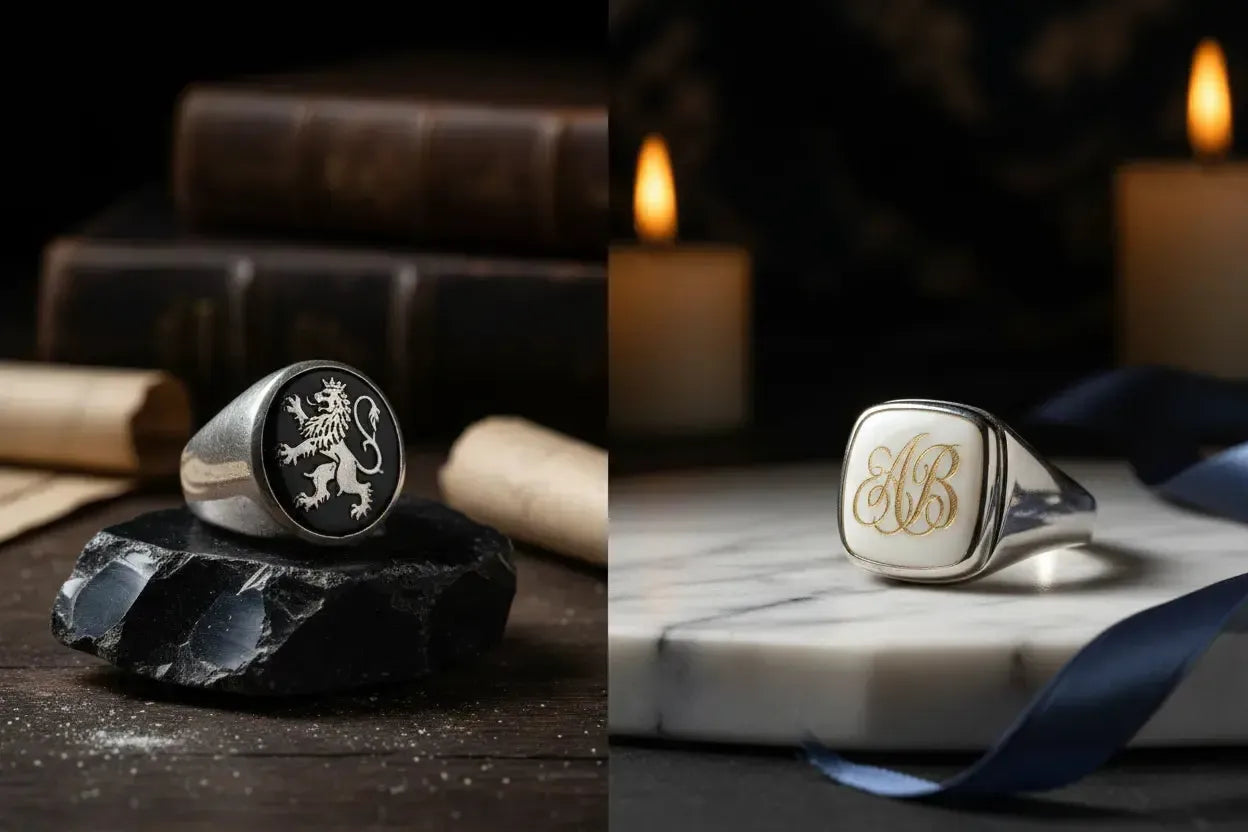
This nascent bourgeoisie wanted the outward signs of status it could not legitimately have. The signet ring was one of them. The solution found was elegant: bourgeois had their rings engraved not with heraldic coats of arms—that would be an usurpation—but with their initials, their monogram, or symbols related to their profession or faith. The form of the signet ring was the same, but the content was different.
This distinction—coats of arms for nobles, monograms for bourgeois—persisted for centuries. It is still visible in 19th-century signet rings: aristocratic families wore their crests, bourgeois families their intertwined initials in elaborate cartouches.
The Revolution and the democratization of jewelry
The French Revolution of 1789 overturned the European social order. The abolition of noble privileges—on the night of August 4, 1789—legally removed restrictions on wearing coats of arms. Anyone could now wear a signet ring with any motif.
Paradoxically, this liberation did not cause an immediate craze for the signet ring among the popular classes. The jewel remained associated with the aristocracy and the upper bourgeoisie. These were the classes that continued to wear it—nobles with their coats of arms, bourgeois with their monograms—but without further legal distinction between the two.
Napoleon created a new nobility—the nobility of the Empire—with its own coats of arms and its own codes. Marshals, ministers, prefects received titles and coats of arms. The signet ring resumed a function of social distinction, but in a new, meritocratic rather than hereditary framework.
The 19th century: the triumphant bourgeois signet ring
It was in the 19th century that the signet ring truly became a bourgeois jewel. The industrial revolution created a powerful and numerous bourgeoisie—industrialists, bankers, doctors, lawyers, engineers—who wanted to assert their social status through outward signs of respectability. The signet ring was one of them.
Jewelers of the time—in Paris, London, Vienna, Milan—offered gold and silver signet rings with engraved monograms, intertwined initials, Masonic or professional symbols. These rings were less massive than medieval noble signet rings, more refined, more adapted to the Victorian and Second Empire aesthetic.
The distinction between noble and bourgeois signet rings gradually faded. What mattered now was the quality of the metal, the fineness of the engraving, the taste of the wearer. The signet ring had become a jewel of social status in the broad sense—not of birth, but of achievement.
The 20th century: the signet ring for everyone
The 20th century completed the democratization of the signet ring. The two world wars reshaped social hierarchies. The middle classes expanded. Industrial jewelry made rings accessible to all budgets. The signet ring was no longer reserved for an elite—it was worn by men of all origins and conditions.
But this democratization came at a cost: the signet ring lost some of its symbolic weight. When everyone can wear one, it doesn't say much about the wearer anymore. This is the paradox of luxury democratization.
The answer to this paradox is the quality of the material and the strength of the motif. A solid 925 sterling silver signet ring with a strong motif—a symbol, a stone, a significant engraving—regains this ability to say something about its wearer. Not his birth rank, but his character, his values, his relationship to the world.
What your signet ring says today
The question is no longer "are you noble or bourgeois?" It is "what do you want to say?" A 925 sterling silver signet ring with a black onyx says something different from a signet ring with a carnelian. A signet ring with a lion motif says something different from a signet ring with Ottoman arabesques.
It is this freedom—to choose what your ring says about you, without constraint of birth or rank—that is the true legacy of this long history. The signet ring has been freed from its social constraints. It remains full of meaning. It's up to you to choose which one.
Complete history of the men's signet ring · The signet ring and European aristocracy · How to choose your signet ring · Men's signet ring collection
✦ Vindicta — Argent 925 Massif
La pièce qui fait la différence
Certifié argent 925 · Livraison offerte dès 69€ · 10 ans d'excellence
Chevalières Homme Argent 925 →


