

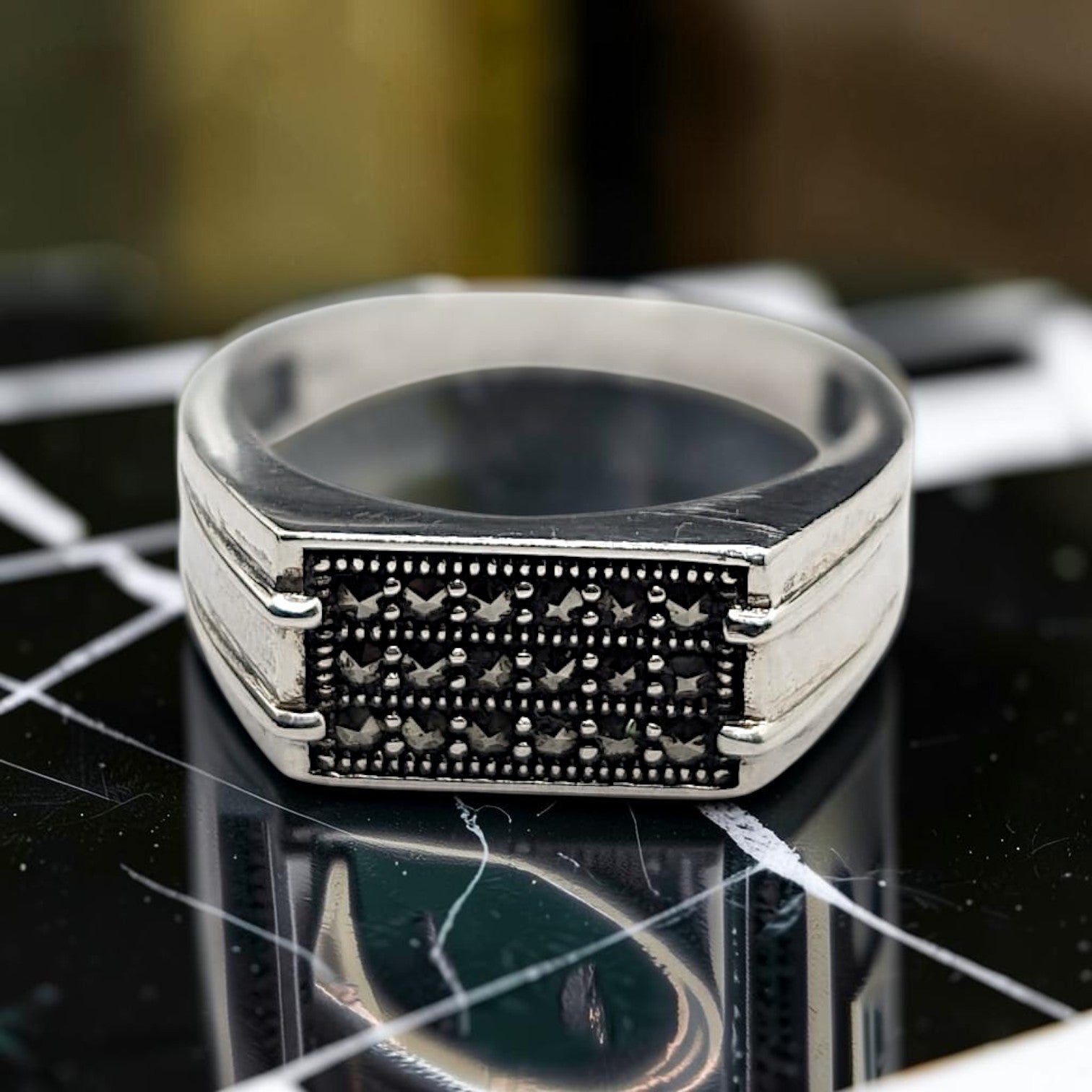
Men's Marcasite 925 Silver Ring — The Dark Elegance of Art Deco
There's an elegance in darkness that gold cannot offer. Marcasite knows this. Its cut facets capture light and reflect it in metallic anthracite flashes—discreet, precise, never vulgar. It's a stone that doesn't shout. It asserts. And that's precisely why it conquered jewelry workshops in the 1920s, and why it's now returning to the wardrobe of men who know what they're wearing.
At Vindicta, marcasite is a cornerstone of our Art Deco identity. Set on solid oxidized 925 silver, it creates a striking contrast—the dark metal and the metallic-sheen stone respond to each other in a harmony of grey, black, and steel. A piece of men's jewelry that doesn't need color to make a statement.
Marcasite or Pyrite: The Confusion to Avoid
First and foremost, an essential point that many are unaware of: the marcasite used in jewelry is not mineralogical marcasite. It's pyrite—FeS₂, iron disulfide—cut into small facets and pavé-set. The confusion stems from the 19th century, when jewelers adopted the term "marcasite" to refer to these small, brilliant metallic stones, and the name stuck.
True mineralogical marcasite is unstable and disintegrates over time—it's never used in jewelry. Pyrite, on the other hand, is stable, hard (6 to 6.5 on the Mohs scale), and perfectly suited for setting. When you see "marcasite" on a quality ring, it's cut pyrite. And that's exactly what you want.
The History of Marcasite in Jewelry
Marcasite has a long history, but it was in the 18th century that it had its first great moment of glory. In Europe, the King of France temporarily banned non-nobles from wearing diamonds—jewelers then turned to marcasite as an elegant and accessible substitute. It imitated the brilliance of diamonds without the price, and European courts enthusiastically adopted it.
But it was in the 1920s and 1930s that it reached its peak. Art Deco—a movement celebrating geometry, precision, and sober luxury—made marcasite its stone of choice. The great Parisian workshops, the jewelers of Bond Street in London, the New York designers: all integrated it into their collections. Pavé-set in a checkerboard pattern, arranged in parallel lines, set in strict geometric motifs—marcasite became the visual signature of an era that valued design intelligence over ostentation.
After World War II, it fell out of fashion along with the rest of Art Deco. But trends always return. Since the 2010s, marcasite has made a noticeable comeback in contemporary jewelry—driven by a renewed taste for vintage, dark-luxe, and jewelry that has a story to tell.